Congruence and similarity: enlarge and shrink a shape with a similarity ratio, see that corresponding sides remain proportional and angles remain congruent; measure the height of a flagpole using shadow lengths and similar triangles in a 3D model
Explore the growth and shrinkage processes of geometric shapes with the congruence and similarity simulation. Thanks to this interactive experiment, you can visually examine the effects of the similarity ratio on corresponding sides and angles, and reinforce the basic features of triangles. Suitable for the 8 grade mathematics curriculum, this tool gives you the opportunity to both practice theoretical knowledge and solve real-life problems.
What can you do in this simulation?
You can observe changes by enlarging and shrinking a shape with different similarity ratios.
You can see that when the shape changes size, its angles remain constant, while its sides increase by a factor of k.
You can test the relationship between the perimeter ratio and the similarity ratio with the 3 ratio trial option.
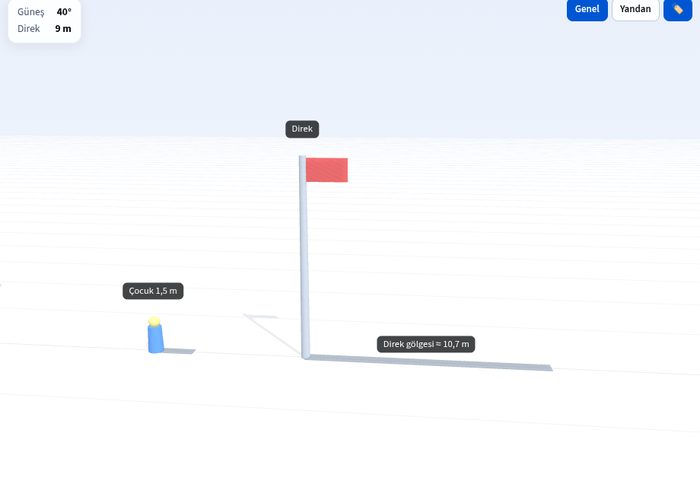
You can measure the height of the flagpole with the help of shadow lengths and similar triangles by trying 2 different sun angles.
Basic concepts and formulas
Similarity in geometric shapes is the condition where corresponding angles are congruent (the same) and corresponding side lengths are proportional. If the similarity ratio is k, the ratio of the perimeters of two similar triangles is also k, but the area ratio changes as k². While calculating height with the help of shadow lengths and similarity in triangles, the following proportion is used: a / b = c / d.
How to use?
Open the experiment panel and follow the guide steps related to similarity and congruence.
Examine side and angle changes by selecting different similarity ratios on the shape.
Observe the shadow lengths of the child and the flagpole by changing the sun angle.
Calculate the height of the pole using similar triangles and check your prediction.
Frequently asked questions
Do the angles of similar triangles change?
No, even if the shape grows or shrinks, the corresponding angles of similar triangles always remain the same.
How does the similarity ratio affect perimeters?
When the similarity ratio is k, the ratio of the perimeters of two shapes also changes directly by the ratio k.
How are shadow length and height found?
Since the angle of sunlight falling on the ground at the same time is constant, the unknown flagpole height can be easily calculated with the help of the side ratios of similar triangles.
 Interactive experiment