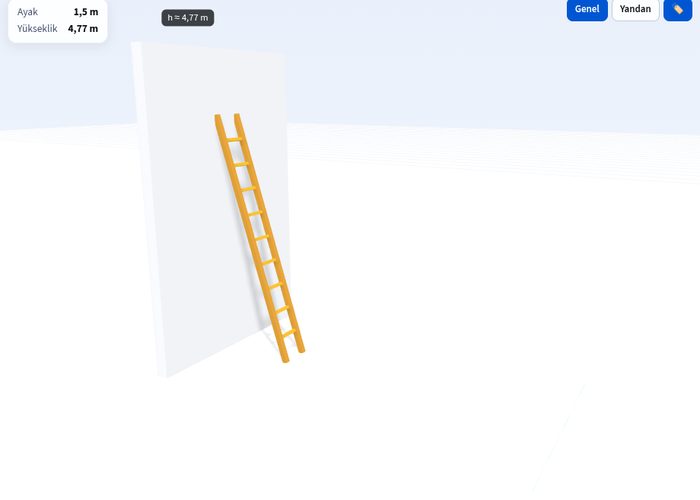
Pythagorean theorem: compare the areas of squares built on the sides of a right triangle, watch the water inside the squares pour to completely fill the larger square; solve the ladder against the wall problem in a 3D model
Explore the fundamental relationship between the sides of a right triangle with the Pythagorean theorem simulation and learn geometric concepts interactively. Through this experiment, you can visually observe the relationship between the areas of the squares of the legs and the square of the hypotenuse. By seeing how the areas combine using the pour water feature, you can make your math lesson more memorable.
What can you do in this simulation?
You can examine the right triangle sides through the Pythagorean theorem simulation.
You can watch how the water in the small squares fills the large square by using the pour water button.
You can solve interactive questions by following the guidance in the guide panel.
You can learn by yourself by saving your predictions and comparing them with the experiment results.
You can instantly test your knowledge with correct and incorrect answer feedback.
Basic concepts and formulas
In a right triangle, the side opposite the 90-degree angle is called the hypotenuse. When the legs are denoted as a and b, and the hypotenuse as c, the Pythagorean theorem is expressed as a^2 + b^2 = c^2. This formula forms the basis for finding the side lengths of right triangles.
How to use?
Open the experiment panel and examine the right triangle model.
Press the pour water button and observe the areas of the small squares filling the large square.
Read the questions in the guide and save your prediction.
Match the cards by dragging and dropping them into the appropriate boxes or by tapping.
Press the check button to test your answer and review your shortcomings.
Frequently asked questions
Which triangles does the Pythagorean theorem apply to?
The Pythagorean theorem applies only to right triangles where one of the interior angles is 90 degrees.
What is the hypotenuse and how is it found?
The hypotenuse is the longest side in a right triangle and is located opposite the right angle. It is calculated with the formula a^2 + b^2 = c^2.
What does the pour water animation represent?
This animation visualizes that the sum of the areas of the squares built on the legs is equal to the area of the square on the hypotenuse.
 Interactive experiment