Triangle inequality and side–angle relationship: adjust the lengths of three sticks, join their ends to see whether a triangle is formed; discover that the largest angle lies opposite the longest side
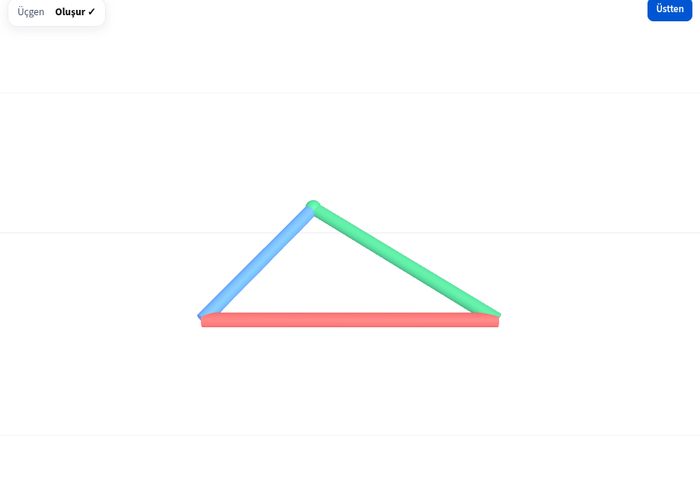
Explore triangle formation rules and side-angle relationships interactively with the triangle inequality simulation. In this application, you can adjust the lengths of three rods to connect their ends, easily learn in which situations a triangle can be drawn, and understand why the largest angle is opposite the longest side. It is a great resource to reinforce theorems in geometry class.
What can you do in this simulation?
You can design triangles with different side lengths by changing the rod lengths.
You can test the rule that the sum of the two short rods must be greater than the long rod.
You can observe invalid cases where the endpoints do not meet.
You can test your predictions through experiments by answering questions guided by the tutor.
You can instantly refresh your knowledge with correct and incorrect feedback.
Basic concepts and formulas
The triangle inequality states that in any triangle, the length of any side must be less than the sum of the lengths of the other two sides and greater than the absolute value of their difference. For sides a, b, and c, this rule is expressed as |b - c| < a < b + c. Furthermore, according to the side-angle relationship, in a triangle, the larger side is opposite the larger angle, and the smaller side is opposite the smaller angle.
How to use?
Open the experiment panel and examine the initial lengths of the rods.
Change the rod lengths by sliding or entering values.
Check whether the endpoints meet and whether a triangle is formed.
Answer the questions in the guide and press the check button.
Try again with different length combinations by using the restart button.
Frequently asked questions
Why is the triangle inequality important?
This rule allows us to determine in advance whether a triangle can be drawn with three given lengths; otherwise, the ends will remain open.
What is the relationship between the longest side and the largest angle?
The longest side is always opposite the largest angle, which determines the geometric balance of the triangle.
What should I do if a triangle is not formed in the simulation?
You can try again by setting the sum of the lengths of the two short rods to be greater than the long rod.
 Interactive experiment