Inequalities: represent inequalities like x < a and x ≥ b on a number line with open and closed endpoints; model real-world situations like an elevator weight limit with inequalities; discover why the direction reverses when multiplying both sides by a negative number
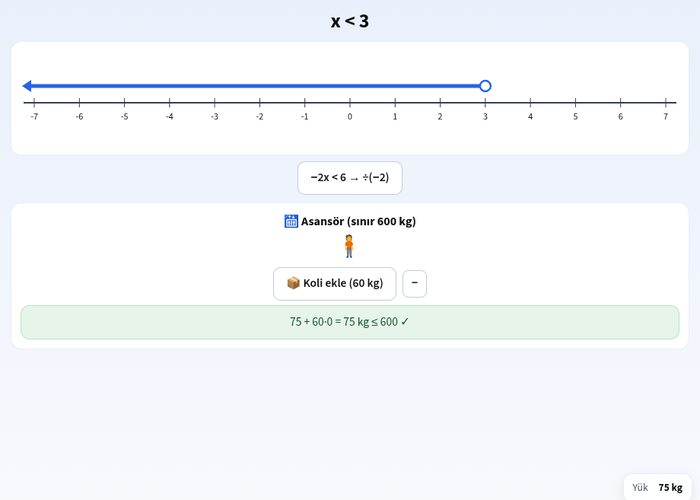
With the inequalities simulation, you can visualize mathematical expressions such as x < a and x ≥ b on the number line using open and closed endpoints, and model real-life situations with inequalities. This interactive experiment, designed to reinforce linear equations and inequalities, helps you grasp number intervals and the rules of reversing direction.
What can you do in this simulation?
You can try 4 different inequality signs: x < a, x > a, x ≤ b, and x ≥ b.
You can place open and closed endpoints in the correct positions on the number line and discover the difference between them.
You can model everyday life problems, such as an elevator load limit, using linear inequalities like 75 + 60x ≤ 600.
You can match cards to the correct boxes by dragging and dropping or by tapping, and receive instant feedback.
You can increase your score by answering questions with the guidance of the guide and review any steps you missed.
Basic concepts and formulas
Inequalities are relations that indicate two mathematical expressions are not equal to each other, using the symbols <, >, ≤, and ≥. When representing them on the number line, an open endpoint (hollow circle) is used for < and >, while a closed endpoint (solid circle) is used for ≤ and ≥. For instance, when the model 75 + 60x ≤ 600 in the elevator problem is solved, x ≤ 8,75 is found, and by rounding down to the base value, it is concluded that at most 8 boxes can be carried.
How to use?
Open the experiment panel and read the guide's instructions.
Match the cards to the correct boxes or columns by tapping or dragging and dropping them.
Test the concepts of open and closed endpoints on the number line.
Set up the inequality in the elevator loading task and verify your answer by clicking the "Check" button.
Move on to advanced steps after correct answers to increase your score.
Frequently asked questions
What is the difference between an open and a closed endpoint on the number line?
An open endpoint (hollow circle) indicates that the boundary value is not included in the inequality (e.g., x < 5), whereas a closed endpoint (solid circle) denotes that the boundary value is included in the solution (e.g., x ≤ 5).
What happens when both sides of an inequality are multiplied by a negative number?
When both sides of an inequality are multiplied or divided by a negative number, the inequality reverses direction (for example, the < sign becomes >).
How is the elevator weight limit problem solved?
The fixed load weight is subtracted from the total limit, and the maximum number of boxes is found by dividing the remainder by the unit box weight and rounding down the resulting decimal number to the nearest smaller integer.
 Interactive experiment