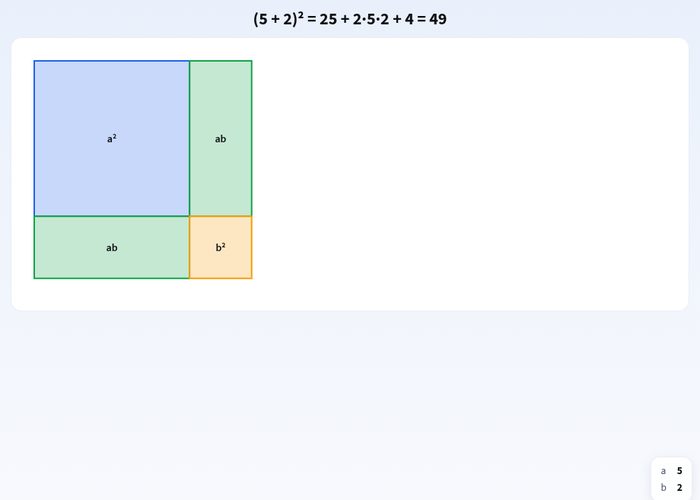
Identities: see that the square (a + b)² equals a² + 2ab + b² by dividing it into four pieces; prove the identity (a − b)² and difference of squares a² − b² = (a − b)(a + b) by cutting and rearranging
With this identities simulation, which allows you to learn the topic of algebraic expressions and identities by visualizing them, you will interactively explore fundamental rules such as (a + b)² and the difference of two squares. By combining and separating pieces, you can clearly see the logic behind the formulas rather than just memorizing them, and reinforce your math skills through practice.
What can you do in this simulation?
You can examine the L-shaped piece remaining when b² is subtracted from the a² square.
By rearranging the cut pieces, you can obtain a rectangle with sides (a − b) and (a + b).
You can place the cards into the correct boxes and columns by dragging and dropping or by touching them.
You can test your predictions through experiments guided step by step and receive instant feedback.
Basic concepts and formulas
Algebraic identities are equations that are true for all values assigned to variables. The difference of two squares identity used in this experiment is expressed with the formula a² − b² = (a − b)(a + b). This visual proof based on areas geometrically allows you to intuitively understand why the formula holds.
How to use?
Open the experiment screen and carefully read the instructions in the guide.
Drag the geometric shapes to the relevant areas using the move piece option.
Fill in the blanks by placing the cards in the correct boxes or columns.
Test your answer by pressing the Check button and see the correct results.
Repeat the experiment using the start over button and reinforce your knowledge.
Frequently asked questions
What is the difference between an identity and an equation?
While an equation holds true only for specific values of the unknowns, an identity is always true regardless of the letter (variable).
How is the difference of two squares formula proven geometrically?
When a small square area is subtracted from a large square area, the remaining area is divided into pieces and recombined to form a rectangle, utilizing the equality of areas.
What topics does this simulation cover?
This simulation covers the topics of algebraic expressions, identities, and area relationships in the 8th grade mathematics curriculum.
 Interactive experiment