Probability of simple events: adjust the colors and quantities of marbles in a bag, calculate the probability; perform hundreds of draws to see on a graph how experimental probability approaches theoretical probability; discover impossible and certain events
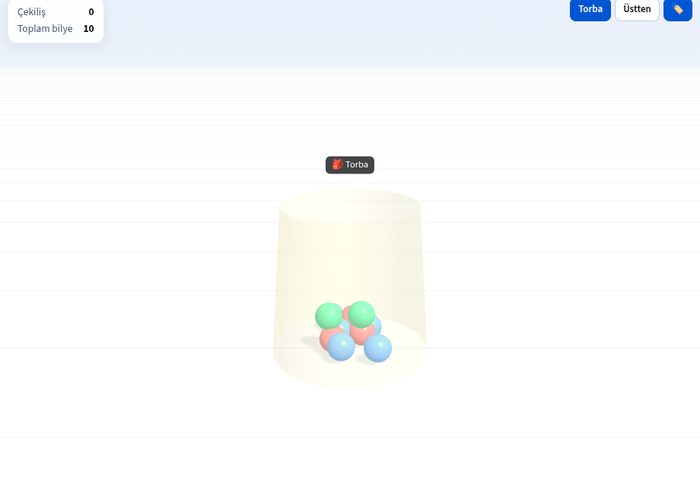
Explore probability calculations in a fun and interactive way with the simple events probability simulation. By adjusting the counts and colors of the marbles in the bag, you can draw 1, 10, or 100 times, and examine how experimental probability approaches theoretical probability with real-time charts.
What can you do in this simulation?
You can customize the numbers of red and green marbles in the bag.
You can collect results by making 1, 10, or 100 draws (drawn marbles are put back into the bag).
You can create impossible and certain event scenarios and observe edge cases.
You can track the distribution of the draw results on a chart.
Basic concepts and formulas
Probability is the mathematical measure of the likelihood of an event occurring. Theoretical probability is calculated with the formula: Number of Outcomes of the Desired Event / Total Number of Possible Outcomes. Experimental probability, on the other hand, is based on data obtained as a result of repeated trials (draws); as the number of trials increases, experimental probability approaches theoretical probability. P(A) = n(A) / n(S)
How to use?
Go to the bag panel and adjust the marble colors and counts as you wish.
Perform 1, 10, or 100 draws using the draw button.
Observe the resulting outcomes and the changes in the chart.
Repeat the experiment by changing the numbers in the bag for impossible or certain events.
Frequently asked questions
Why is the drawn marble put back into the bag?
Putting the drawn marble back ensures that the probability of the event remains constant at each draw (due to the independent events rule).
Why might experimental probability and theoretical probability turn out differently?
Especially when a small number of draws are made (e.g., 1 or 10 times), results may deviate from the theoretical value due to the factor of luck, but when the number of draws reaches hundreds of times, the two values get closer to each other.
What is an impossible event?
It is an event with a zero probability of occurring; for example, drawing a red marble from a bag that contains no red marbles at all is an impossible event.
 Interactive experiment