Decimal and scientific notation: read magnitudes in scientific notation on the scale slider from atom to galaxy; convert a number into the form a × 10ⁿ by shifting the decimal point; compare very large and very small numbers
Interactively explore writing very large and very small numbers in the form a times 10 to the power of n with the Decimal and Scientific Notation simulation. Using the scale slider from atom to galaxy, you can compare different magnitudes from hydrogen to the Milky Way and reinforce your math skills with fun questions.
What can you do in this simulation?
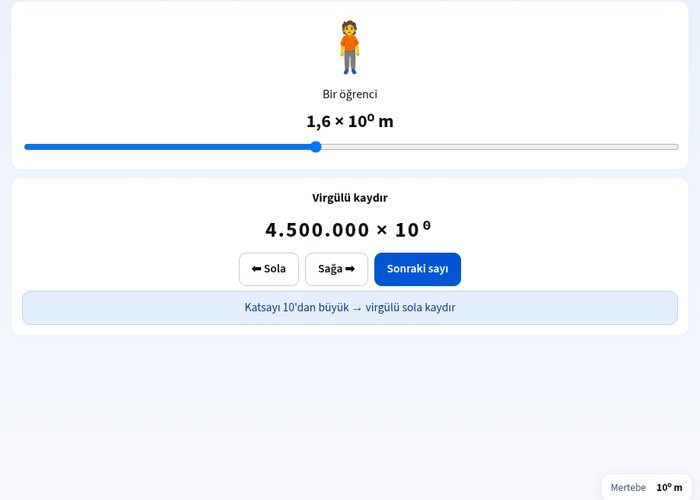
You can examine the measurements of different objects such as a hydrogen atom diameter, bacteria, hair strand thickness, ant, student, and Mount Ararat.
You can compare astronomical distances such as the Earth, Earth-Moon distance, Earth-Sun distance, and the diameter of the Milky Way.
You can switch between different magnitude scales of the universe, from atoms to galaxies, using the scale slider.
You can practice converting decimal numbers into scientific notation by shifting the decimal point right or left.
You can solve guided interactive questions to reach the correct answers and track your progress.
Basic concepts and formulas
Scientific notation is used to express very large or very small numbers in a practical way. Scientific notation is written in the form a times 10 to the power of n, where the coefficient a is a real number between 1 and 10 (1 less than or equal to a less than or equal to 10), and n is an integer. If the decimal point is shifted left to make the number larger, the exponent (n) increases; if the decimal point is shifted right to make the number smaller, the exponent (n) decreases.
How to use?
Open the experiment and review the guidelines provided with the guide.
Observe the magnitudes of different objects and distances from the atom to the galaxy by moving the scale slider.
Examine the cards or questions that appear and convert the numbers according to the rules of scientific notation.
Test your predictions and see your shortcomings by clicking the check answer button.
Continue practicing with different scenarios using the restart button.
Frequently asked questions
Why must the coefficient be between 1 and 10 in scientific notation?
To ensure a standard expression unity in mathematics and to make it easier to compare very large or very small numbers, the rule has been adopted that the absolute value of the coefficient must be in the range including 1 and 10.
How does the exponent change when I shift the decimal point to the left?
For every decimal place you move the decimal point to the left to make the number smaller, the exponent (n), which is a power of 10, is increased by one.
Why are exponents negative in very small numbers?
When converting decimals smaller than 1 into scientific notation, we shift the decimal point to the right, and the exponent takes a negative value equal to the number of places shifted.
 Interactive experiment