Factors and multiples: find all factors of a number by arranging square tiles into rectangular shapes, break down a number step by step in a prime factor tree, mark multiples of a number on a number line
Explore the factors and multiples of a natural number with interactive activities using the factors and multiples simulation. In this application, you can find all the factors of a number by arranging square tiles in a rectangular format, step-by-step break down numbers into their prime factors with the help of a prime factor tree, and examine the multiples of a number on the number line. By reinforcing these fundamental topics in mathematics, you can easily grasp the logic behind factors and multiples.
What can you do in this simulation?
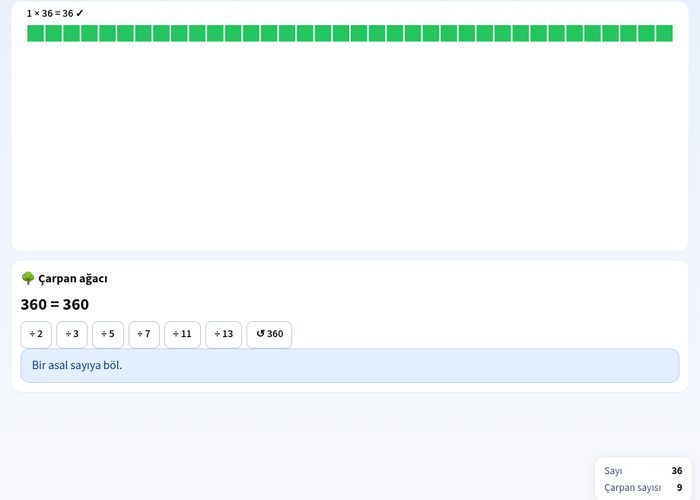
You can create all possible rectangular arrangements for a given number using square tiles and find the factors.
You can break down numbers into their divisors and follow the steps with the help of the prime factor tree.
You can mark the multiples of the number on the number line and observe the relationship between them.
You can solve interactive questions guided by a tutor and test your predictions with experiments.
Basic concepts and formulas
Numbers that divide a natural number without a remainder are called the factors (divisors) of that number. For example, the factors of the number 36 are 1, 2, 3, 4, 6, 9, 12, 18 and 36. A prime factor is a number greater than 1 that has no positive integer divisors other than itself. The multiples of a number, on the other hand, are an infinite sequence of numbers obtained by multiplying that number by positive integers such as 1, 2, 3, …
How to use?
Open the experiment, read the tutor's instructions and select the first activity.
Drag and drop cards or tiles into the relevant boxes or columns.
Create rectangular models to find factors or complete the prime factor tree step by step.
Verify your answers by clicking the check button and review your missing points.
Frequently asked questions
How do we find how many factors a number has?
To find the factors of a number, you can find the positive integers that divide that number without a remainder, or you can list all possibilities by forming rectangles with square tiles as in this simulation.
What is a prime factor and how is it found?
A prime factor is the set of prime numbers that divide a number without a remainder. Using the prime factor tree method in the simulation, you can divide the number starting from the smallest prime number and break it down into its prime factors.
Are the multiples of numbers finite?
No, there are infinitely many multiples of a number. For example, the multiples of a number continue to increase on the number line as its 1, 2, 3 multiples.
 Interactive experiment