Integer powers of integers: see how the sign changes for odd and even powers of a negative base using a tower model; discover positive exponents with a dividing bacteria colony and negative exponents with a halving cake
Interactively explore the topic of exponential expressions and learn the powers of negative bases with the integer powers of integers simulation. This online math simulation is designed for 8th-grade students to reinforce the rules regarding exponential numbers. You can easily grasp sign changes in odd and even powers of negative bases, as well as the logic behind positive and negative exponents through interactive activities.
What can you do in this simulation?
You can examine how the sign changes in odd and even powers of a negative base using the tower model.
You can try at least 4 different exponent trials for the expression (-3)ⁿ and observe the results.
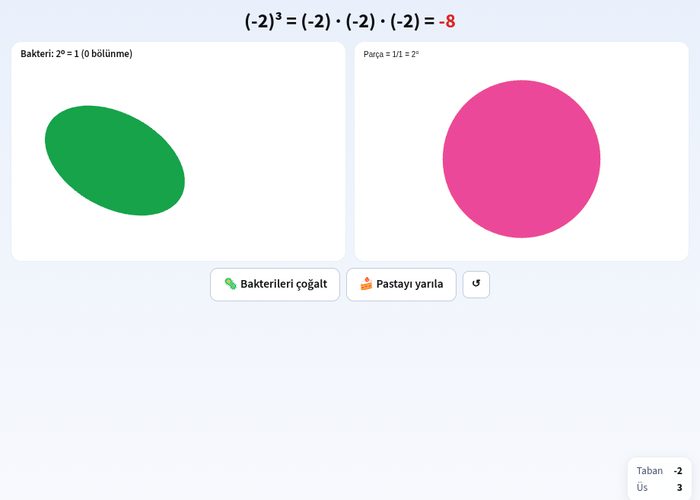
You can discover the growth logic of positive exponents with the bacteria colony model that divides in two.
You can examine fractional results of negative exponents through the halved cake model.
You can test what you have learned with questions by dragging and dropping cards into the correct boxes.
Basic concepts and formulas
The nth power of an integer a is denoted as aⁿ. When the base is negative, if the exponent is even, the result is positive; if the exponent is odd, the result is negative. Negative exponents take the reciprocal of the number: a⁻ⁿ = 1 / (aⁿ). For example, (-2)² = 4, while (-2)³ = -8.
How to use?
Open the experiment screen and follow the steps with the guide.
Check the results by changing the base and exponent values in the tower model.
Examine the relationship between positive and negative exponents using the bacteria and cake models.
Test your accuracy by answering the questions and saving your predictions.
Frequently asked questions
Is the power of a negative base always negative?
No, if the exponent of a negative base is an even number, the result is positive; if it is an odd number, the result is negative.
What does a negative exponent mean?
A negative exponent turns the base of the number into a positive exponent by reciprocating it, meaning it moves the number to the denominator.
What topics does this simulation cover?
The simulation covers the topics of integer powers of integers and exponential expressions in the 8th-grade mathematics curriculum.
 Interactive experiment