Transformer: set primary and secondary turns and input voltage; Vs/Vp = Ns/Np and power conservation in an ideal transformer; calculate how high voltage reduces I²R loss in power transmission lines
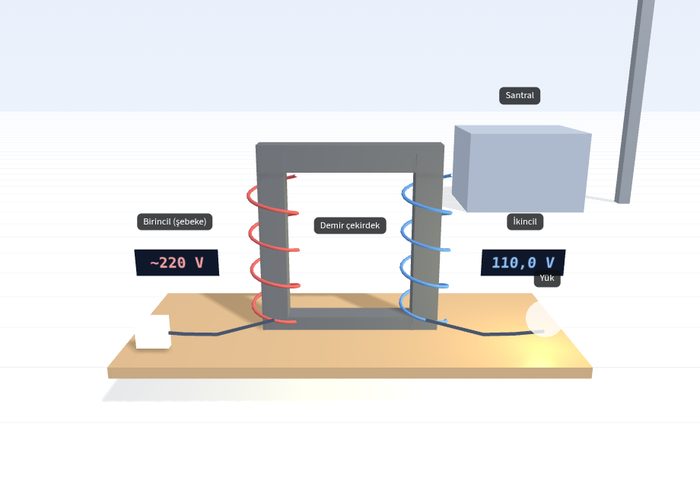
Are you ready to interactively explore one of the most important topics of the electricity and magnetism unit with the transformers simulation? Thanks to this educational tool, you can observe how the output voltage changes by modifying the primary and secondary winding numbers and the input voltage. By examining power conservation in an ideal transformer, you can easily grasp how high voltage reduces I²R heat losses in power transmission lines.
What can you do in this simulation?
You can observe voltage ratios by changing the primary and secondary winding numbers.
You can examine the difference between step-up and step-down transformers by adjusting the input voltage.
You can achieve target output voltages such as 11 V and 4400 V in different scenarios.
You can calculate and analyze current and power losses in energy transmission lines.
You can reinforce your theoretical knowledge with card matching and guided questions.
Basic concepts and formulas
Transformers are electromagnetic devices used to change alternating current voltage. Their basic operating principle is based on Faraday's Law. The basic formula is Vs / Vp = Ns / Np, where V represents voltage, N represents the number of turns, p represents the primary circuit, and s represents the secondary circuit. In an ideal transformer, input power equals output power (Vp·Ip = Vs·Is). In long-distance energy transmission, the voltage is stepped up and the current is stepped down, thereby reducing power losses over the line (I² · R) to a minimum level.
How to use?
Go to the experiment panel, read the guide steps, and examine the targeted output voltage.
Adjust the transformer ratio by changing the primary and secondary winding numbers.
Observe the system response and output values by entering the input voltage value.
Calculate current and power losses in step-up or step-down modes.
Test your predictions and complete your missing points by using the check button.
Frequently asked questions
Do transformers work with direct current (DC)?
No, transformers only work with alternating current (AC). A continuously changing current creates a time-dependent changing magnetic flux on the iron core, producing voltage via induction in the secondary winding.
What is the efficiency of an ideal transformer in percent?
In an ideal transformer, energy loss is neglected, so the efficiency is one hundred percent. The input power equals the output power drawn from the secondary circuit.
Why is high voltage preferred in power transmission lines?
In intercity power transmission, the current is reduced to largely prevent I²R heat losses caused by line resistance.
 Interactive experiment