Electromagnetic induction: push, pull, or hold a magnet near a coil; observe the deflection and direction of the galvanometer; effect of speed, number of turns, and magnet strength on induced emf (Faraday) and Lenz's law
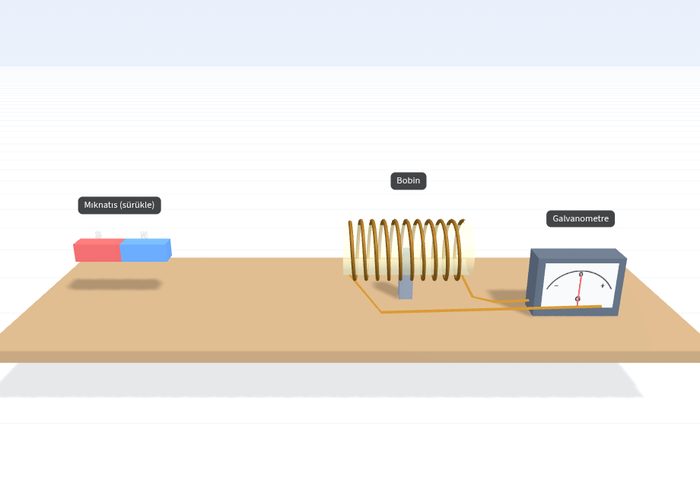
Discover the phenomenon of electromagnetic induction step by step with the induction current simulation and learn Faraday's and Lenz's laws interactively. In this experiment, you can observe the generation and direction of the current by moving the magnet closer to and further away from the coil. It is a great tool to reinforce electricity and magnetism topics in physics class.
What can you do in this simulation?
You push, pull, or hold the magnet relative to the coil.
You monitor the amount and direction of the deflection on the galvanometer.
You examine the effect of the magnet's movement speed on the induction emf value.
You test the relationship with emf by changing the number of coil turns.
You observe the poles formed and the current direction according to Lenz's law.
Basic concepts and formulas
Electromagnetic induction is the production of an electric current by changing the magnetic flux within a closed circuit. According to Faraday's law, the induced electromotive force (emf) depends on the rate of change of flux and the number of turns. It is expressed formulaically as ε = -N · (ΔΦ / Δt). Here, N represents the number of turns, and ΔΦ/Δt shows the rate of change of magnetic flux with respect to time. The minus sign in Lenz's law indicates that the induction current is in the direction of opposing the flux change that created it.
How to use?
Bring the magnet closer to or further away from the coil by dragging it with your mouse or finger.
Change the movement speed and observe how the current value on the galvanometer changes.
Compare the results by changing the number of turns settings.
Observe that the current is zero when you keep the magnet stationary inside the coil.
Follow the guide steps to answer the questions and test your knowledge.
Frequently asked questions
Why is no current generated when the magnet is stationary inside the coil?
According to Faraday's law, for an induction current to be generated, the magnetic flux must change. When the magnet is stationary, the flux remains constant, so the current becomes zero.
How does increasing the number of turns affect the emf value?
As the number of turns (N) increases, the induced emf in the coil and the resulting current also increase in direct proportion.
What does Lenz's law express?
Lenz's law explains that the induction current always arises in a direction to oppose the change in the magnetic field that created it, and it is a consequence of the conservation of energy.
 Interactive experiment