Magnetic field and force: change the circular path of a charged particle entering a magnetic field perpendicularly by varying velocity, field, and charge sign (r = mv/qB); magnetic field of a current-carrying wire and the force acting on a wire in the field F = B·I·L·sin θ
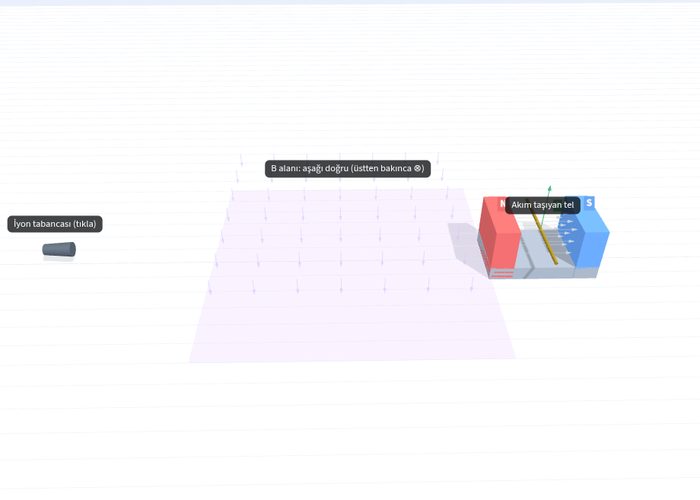
Explore the fundamental principles in the electricity and magnetism unit interactively with the magnetic field and magnetic force simulation. In this experiment, you will observe the behavior of charged particles moving in a magnetic field and the forces acting on current-carrying wires.
What can you do in this simulation?
You can examine the paths followed by charged particles entering a magnetic field.
You can test magnetic force calculations acting on a current-carrying wire.
You can change the velocity, magnetic field, and charge sign parameters of the particles.
You can reinforce your theoretical knowledge with guided questions and prediction steps.
You can ensure instant learning with correct and incorrect answer feedback.
Basic concepts and formulas
Moving charges and current-carrying wires in a magnetic field are subject to a force. The radius of the circular trajectory drawn by a charged particle in a magnetic field is given by the formula r = m·v / (q·B). The magnetic force acting on a current-carrying wire is calculated with the relation F = B·I·L·sin θ; where B represents the magnetic field strength, I the current, L the length of the wire, and θ the angle value.
How to use?
Check out the experiment panel and guide instructions on the simulation screen.
Set the relevant parameters (velocity, current, magnetic field) and save your prediction.
Answer the questions and place the cards into the appropriate boxes or columns.
Check the results and repeat the steps if necessary.
Frequently asked questions
How does a magnetic field affect a wire?
When a current-carrying wire is placed in a magnetic field, it is subjected to a magnetic force due to the moving charges on the wire, and this force causes the wire to deflect.
What factors does the radius of the circular trajectory take into account?
The mass, velocity, charge amount of the particle, and the magnitude of the magnetic field directly affect the radius of the circular motion.
What does the angle in the formula represent?
The angle θ indicates the directional angle value between the current-carrying wire and the magnetic field vector.
 Interactive experiment