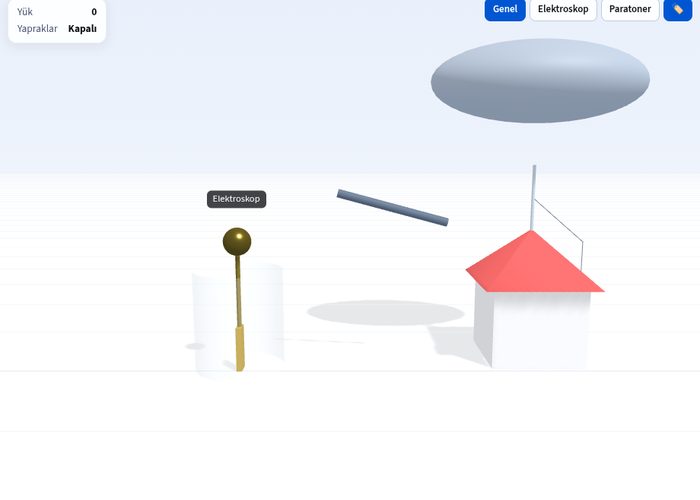
Electrically charged objects and grounding: bring a charged rod close to and touch it to the knob of an electroscope, understand whether the object is charged by the leaves opening; see grounding by touching the knob, watch how a lightning rod protects the building from lightning
Interactively explore how an electroscope works, the charge status of objects, and the grounding phenomenon with the electrically charged objects and grounding simulation. Through this experiment, you can observe the transfer of electrical charges between objects, the movement of electroscope leaves, and how lightning rods protect buildings from lightning. Enabling you to learn by testing physical principles step by step, this tool is perfect for reinforcing electricity unit topics in science class.
What can you do in this simulation?
You can observe the movement of the leaves by bringing a charged rod close to the knob of the electroscope.
You can touch the charged rod to the electroscope to cause permanent charging and the leaves to open.
You can ground the electroscope to watch excess charges flow to the ground and the leaves close.
You can examine the lightning rod's building protection mechanism by activating it.
Basic concepts and formulas
An electroscope is a device used to determine whether an object is electrically charged and, if so, the type of charge. When an object touches it, like charges repel each other and the leaves open. Grounding is the process of neutralizing an object by transferring excess or harmful charges to the earth via a conductive line.
How to use?
Open the experiment panel and bring electrically charged objects close to the electroscope.
Touch the rod to the electroscope's knob and examine the state of the leaves.
Use the grounding option to observe the movement of charges and the closing of the leaves.
Run the lightning rod simulation to observe its protective effect on buildings.
Frequently asked questions
Why do electroscope leaves open?
When charge transfer occurs between an object and an electroscope, or as a result of charging by induction, the leaves acquire the same type of charge and repel each other.
What happens to an electroscope when it is grounded?
Excess charges are transferred to the ground through the human body or a conductive line, rendering the electroscope neutral and causing its leaves to close.
How does a lightning rod protect buildings?
It prevents damage to the building by safely transferring electrical charges from clouds to the ground.
 Interactive experiment