Electric charges and electrification: observe electron transfer by rubbing a balloon against wool fabric, bring charged balloons close to each other and see repulsion-attraction; compare electrification by friction, contact, and induction; attract paper pieces with a charged rod
Discover the electrification of matter around us with the electric charges and electrification simulation. Observe electron transfer by rubbing a balloon on woolen cloth, and examine the attractive and repulsive forces of charged objects.
What can you do in this simulation?
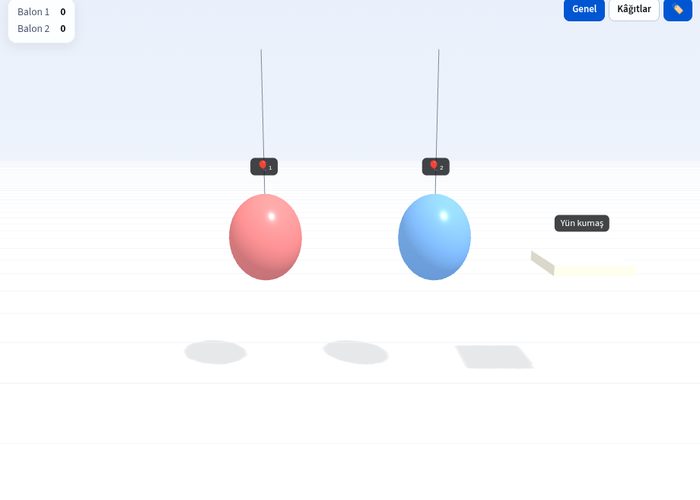
You can charge the balloon negatively by rubbing it against woolen cloth.
You can test attractive and repulsive forces by bringing charged balloons closer to each other.
You can observe the effect by bringing a charged rod close to neutral pieces of paper.
You can compare the methods of charging by friction, contact, and induction.
You can reinforce your knowledge by answering guided interactive questions.
Basic concepts and formulas
Matter consists of atoms and is normally neutral. As a result of charging by friction, electrons are exchanged between objects. An object that gains electrons becomes negatively (-) charged, while an object that loses electrons becomes positively (+) charged. Like charges repel each other, while opposite charges attract each other.
How to use?
Open the experiment panel and charge the balloon by rubbing it against woolen cloth.
Track the status of the charged balloon and electron transfer on the screen.
Observe the repulsion or attraction by bringing charged objects closer to neutral objects.
Test your knowledge by placing the cards in the appropriate boxes.
Frequently asked questions
Which particle moves during charging by friction?
Only electrons move during charging by friction. Protons cannot change position because they are bound in the nucleus.
What do like charges do to each other?
Objects with like electric charges exert a repulsive force on each other.
Why are neutral objects attracted by charged objects?
When a charged object is brought near a neutral object, it affects the charge distribution, causing polarization and creating an attractive force.
 Interactive experiment