Biotechnology: cut the insulin gene from human DNA using a restriction enzyme, insert it into a bacterial plasmid, replicate the bacteria, and monitor insulin production; evaluate biotechnology applications with their benefits and potential risks
Discover gene transfer processes step-by-step and experience insulin production with the biotechnology simulation. This interactive activity allows you to reinforce the genetic engineering concepts you learned in the 8th grade Science DNA and Genetic Code unit. You can learn interactively how useful products are obtained by altering the genetic makeup of living organisms.
What can you do in this simulation?
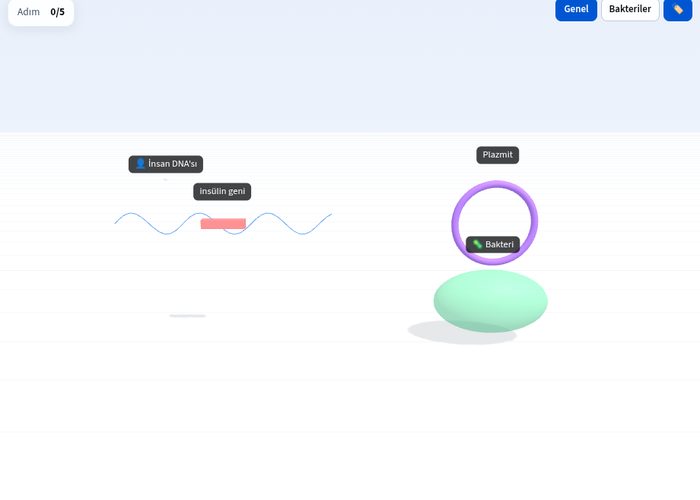
You can cut the insulin gene from human DNA using a restriction enzyme.
You can examine the genetic structure by opening the circular plasmid of the bacterium.
You can create recombinant DNA by inserting the cut insulin gene into the plasmid.
You can complete gene transfer by transferring the recombinant plasmid into the bacterium.
You can multiply the bacterium, observe insulin production, and distinguish biotechnology applications.
Basic concepts and formulas
Biotechnology is the branch of science that gives living organisms new functions using genetic engineering methods. Gene transfer takes place by adding a gene taken from one organism into the DNA of another organism. In this process, restriction enzymes cut DNA at specific sites, and through recombinant DNA technology, vital proteins such as insulin can be produced in laboratory environments via bacteria.
How to use?
Separate the relevant gene from human DNA by clicking the cut insulin gene button.
Open the circular DNA of the bacterium with the appropriate enzyme using the open plasmid option.
Create the recombinant DNA structure with the insert gene into plasmid step.
Complete the process with the transfer to bacterium and multiply bacterium buttons.
Frequently asked questions
What does the biotechnology simulation show?
This simulation visually and interactively demonstrates how the human insulin gene can be transferred into a bacterium to produce insulin in series.
What is recombinant DNA?
It is a new DNA molecule formed by combining DNA fragments from different sources. It plays a fundamental role in gene transfer.
In which fields is gene transfer used?
It is applied in many fields such as medicine, agriculture, and livestock for hormone production, developing disease-resistant plants, and criminal identification in forensic science.
 Interactive experiment