Adaptation: change the tree bark color, catch butterflies that stand out to your bird eye, and see how camouflage color frequency increases in the population over generations; match the adaptations of living things in different environments
If you want to discover how living things adapt to their environments, the adaptation simulation is just for you! In this interactive activity, you will observe the effect of natural selection on a population by changing tree bark color, catching butterflies, and advancing generations. You will learn the fundamental mechanisms of biodiversity by matching the adaptations of organisms in different environments.
What can you do in this simulation?
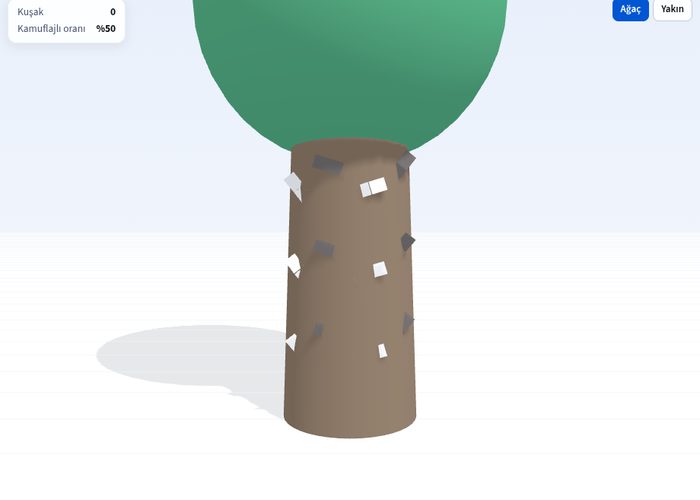
You can change the tree bark color and experience hunting by clicking on the butterflies on the tree in bird-mode.
With every 6 catch, you can ensure the birth of a new generation and advance 3 generations to track the change in the camouflaged ratio within the population.
You can test the adaptations of living things in different environments like deserts and forests using matching cards.
You can examine the characteristics of different organisms such as chameleons, bats, and hedgehogs and place them into the correct categories.
You can record your predictions, test the experiment to check the results, and proceed with the guide.
Basic concepts and formulas
Adaptation is the acquisition of inherited traits that increase the chances of survival and reproduction of living things in a particular environment. Natural selection is the process by which individuals best adapted to the environment survive and pass their genes on to subsequent generations. In this simulation, you will statistically see how the camouflage ratio (Camouflaged ratio = Number of camouflaged individuals / Total number of individuals) increases over generations.
How to use?
Open the experiment panel, read the guide, and review the targeted steps.
Play the role of a bird by clicking on the butterflies on the tree and watch new generations be born with every 6 catch.
Match the cards by tapping or dragging and dropping them into the relevant boxes, filling in all the blanks.
Verify your predictions by clicking the Check button and analyze the results.
Try different scenarios again using the Start Over button and complete your missing areas.
Frequently asked questions
How is adaptation passed down from generation to generation?
Since adaptations are genetically based inherited traits, they are passed on to subsequent generations through DNA and become widespread in the population.
How does natural selection affect the butterfly population?
Butterflies that cannot adapt to the color of the environment are more easily caught by predators, while those with camouflage abilities survive and reproduce, increasing their numbers.
Is every modification an adaptation?
No, modifications such as building muscle through exercise are caused by environmental effects and are not hereditary, so they are not passed on to future generations.
 Interactive experiment