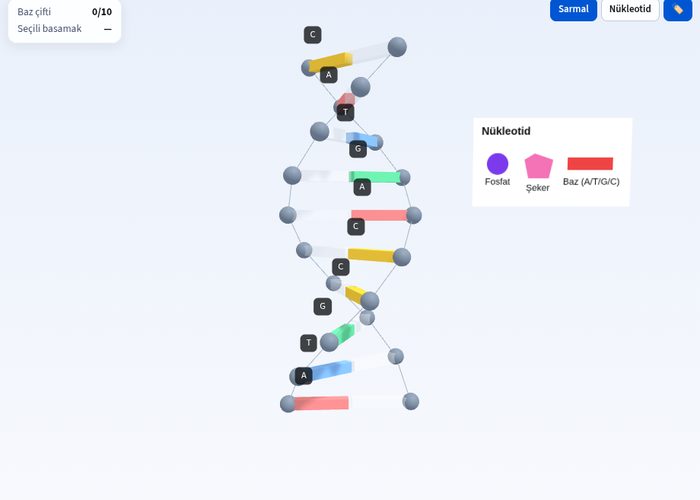
DNA and genetic code: complete the bases of the complementary strand in the 3D double helix (A–T, G–C), examine the nucleotide–gene–DNA–chromosome relationship layer by layer, and watch DNA replication step by step
Take a close look at the fundamental molecule of life with the DNA and genetic code simulation and interactively learn nucleotide pairings. In this experiment, while exploring the 3-dimensional structure of DNA, you will experience how adenine, thymine, guanine, and cytosine bases complement each other. It is a great opportunity to reinforce genetic code topics in your science lessons during the LGS preparation process.
What can you do in this simulation?
You can complete the bases of complementary strands on the 3D double helix according to correct rules.
You can place the 10 base pairs by making A-T and G-C pairings.
You can examine the structural size relationship between nucleotide, gene, DNA, and chromosome layer by layer.
You can follow the DNA replication process step by step and receive feedback on correct pairings.
Basic concepts and formulas
DNA (Deoxyribonucleic Acid) consists of building blocks called nucleotides. Each nucleotide contains a phosphate, a deoxyribose sugar, and an organic base. Organic bases are divided into four categories: Adenine (A), Thymine (T), Guanin (G), and Cytosine (C). In the double helix structure, Adenine always pairs with Thymine, and Guanine always pairs with Cytosine (A=T and G≡C).
How to use?
Open the experiment panel and click on an empty step on the helix.
Select and place the correct base (A, T, G, or C) that should correspond to it.
Correct mismatched pairings by following the hints and feedback.
See your score when all blanks are filled and the double helix is completed.
Frequently asked questions
Which base pairs with the adenine nucleotide?
The thymine (T) nucleotide always pairs with the adenine (A) nucleotide.
What is the fundamental building block of DNA?
The fundamental building block of DNA is the nucleotide. A nucleotide is named after the organic base in its structure.
Is this simulation useful for LGS preparation?
Yes, it is ideal for reinforcing the DNA and genetic code unit in the 8th grade science curriculum.
 Interactive experiment