CERN, TÜBİTAK, TENMAK, TUA, NASA… Physics-related professions and career roadmap
The Exploring Careers in Physics simulation is an interactive activity that enables you to learn about physics as a science and career roadmaps. You will get to know physics-based professions closely by exploring the working areas of prestigious institutions such as CERN, TÜBİTAK, TENMAK, TUA, and NASA.
What can you do in this simulation?
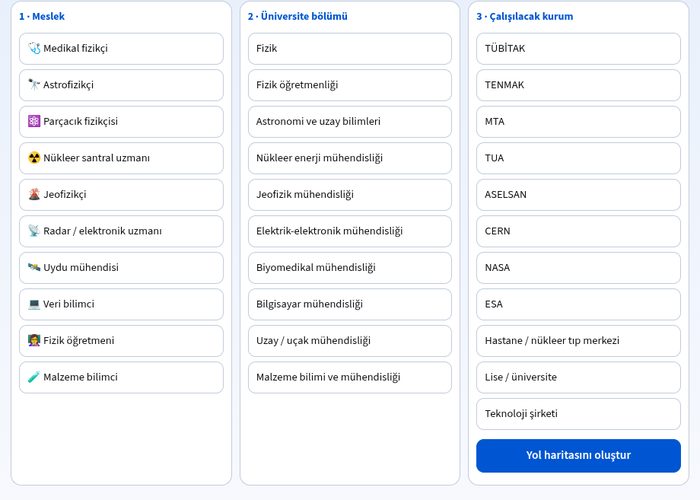
- You can examine the fields of activity of leading research centers such as CERN, TÜBİTAK, TUA, and NASA.
- You can discover professional groups such as particle physics, astrophysics, nuclear energy, and medical physics.
- You can match professions with related institutions and sub-branches through card-matching and drag-and-drop activities.
- You can see career routes such as engineering, teaching, and data science that can be pursued after an undergraduate physics education.
- You can check your answers with the help of the guide and create the correct career roadmap.
Basic concepts and formulas
Physics does not only offer theoretical knowledge; it forms the basis of many industries such as engineering, medicine, space, and the defense industry. For example, while solid-state physics plays a role in the development of technology and nanotechnology, nuclear physics is used in energy production and the medical field. In this simulation, the relationship between professions and sub-branches is based on this core foundation: Expertise = Physics Foundation + Engineering / Research Application.
How to use?
- Read the cards and descriptions on the screen carefully.
- Select the card and place it by tapping the category or box it belongs to.
- Test your accuracy by pressing the check prediction button.
- Review missing or incorrect matches and try again using the start over button.
- Complete the entire career roadmap and review the guide's feedback.
Frequently asked questions
In which institutions can physics graduates work?
Physics graduates can work in national and international research centers such as CERN, TÜBİTAK, TENMAK, and TUA, in nuclear medicine units of hospitals, in defense industry companies, and in technology firms.
What is required to become a medical physicist?
After completing your undergraduate education in physics, you can work in radiotherapy, radiology, and nuclear medicine departments of hospitals by pursuing a master's degree in medical physics.
What is the relationship between physics and space sciences?
Rocket technologies, satellites, telescopes, and astrophysical analyses used in space research are directly based on laws of physics such as mechanics, electromagnetism, and optics.
 Interactive experiment