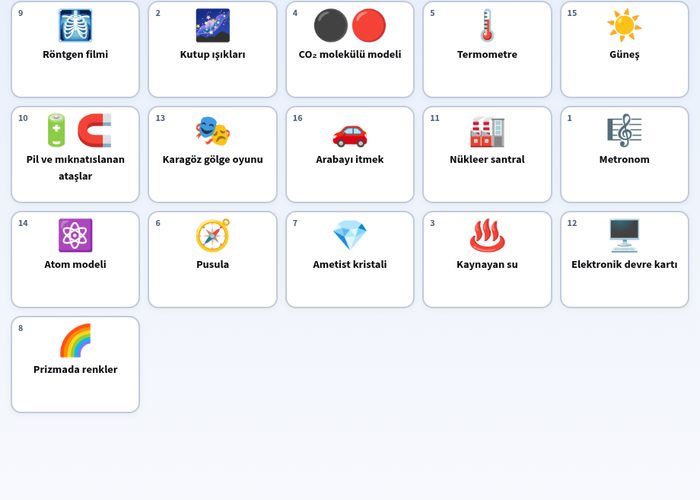
Classify 16 phenomena into 8 subfields: mechanics, electromagnetism, thermodynamics, optics, solid-state, atomic, nuclear, high-energy, and plasma physics
With the subbranches of physics simulation, you will discover in a fun way how everyday phenomena relate to different sub-disciplines of physics. In this interactive activity, you will have the opportunity to reinforce core fields such as mechanics, thermodynamics, optics, and electromagnetism, as well as solid-state physics, atomic physics, nuclear physics, and high-energy and plasma physics.
What can you do in this simulation?
- You can examine 16 different physical phenomena and match them with the correct subbranches.
- You can place the cards into the corresponding boxes by dragging and dropping or tapping.
- You can learn why a phenomenon belongs to a specific branch by reading the hints and descriptions below each one.
- You can check your choices and get instant feedback to identify your shortcomings.
- You can reset the experiment with the restart button and try different combinations again.
Basic concepts and formulas
Physics has a very broad scope for understanding the universe, and this scope is divided into subbranches. For example, mechanics deals with force and motion (F = m·a), while optics examines the propagation and refraction of light. Thermodynamics handles heat and temperature changes, whereas electromagnetism focuses on electric charges and magnetic fields. Solid-state physics examines crystal structures, and atomic physics studies the structure of atoms and energy levels.
How to use?
- Examine the cards and subbranch boxes on the simulation screen.
- Tap or drag a card to move it to the box you think it belongs to.
- After placing all the cards, press the check button.
- Review the feedback provided and correct any mismatched pairs.
Frequently asked questions
Why is it important to learn the subfields of physics science?
Since physics is a very broad science, dividing topics into sub-disciplines makes studying easier and guides the development of technology.
What fields does solid-state physics deal with?
Solid-state physics examines the solid-state crystal structures, elasticity, and magnetic properties of materials; touchscreens and semiconductors fall into this field.
Where do we encounter plasma physics in daily life?
Auroras, the structure of the sun, and fluorescent lamps are the main phenomena examined by high-energy and plasma physics.
 Interactive experiment