Scientists from Ibn al-Haytham to Hawking: timeline, contributions, and characteristics of a scientist
The pioneers of physics science simulation is an interactive activity that allows you to discover the lifespans, eras, and contributions to science of scientists who left their mark on history, from Ibn al-Haytham to Stephen Hawking. In this study, you will match scientists with the correct centuries and test the nature of scientific knowledge and scientist characteristics through interactive questions. By gaining knowledge about the history of physics, you will learn the origins of the scientific method.
What can you do in this simulation?
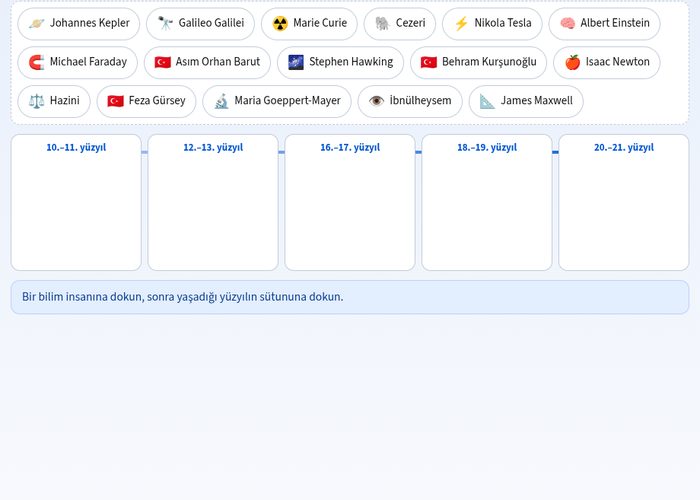
- You can place 16 different scientists on the timeline according to the centuries they lived in.
- You can examine the contributions and scientific works of scientists.
- You can test your critical thinking skills by questioning the characteristics of scientists.
- You can check your correct and incorrect guesses with the guide and eliminate your shortcomings.
- You can solve matching puzzles by dragging and dropping or tapping the cards.
Basic concepts and formulas
Physics science is not the product of a single person or era, but a universal process that progresses cumulatively over centuries. From Ibn al-Haytham's optical studies to Newton's laws of mechanics, Maxwell's electromagnetism equations, and Einstein's theory of relativity, every step is based on observation, experiment, and evidence. The principles of skepticism, curiosity, searching for evidence, and measuring lie at the foundation of scientific knowledge.
How to use?
- Examine the timeline and century columns on the activity screen.
- Select a scientist card by tapping on it.
- Place the card by tapping the column of the century in which that scientist lived.
- Answer multiple-choice questions about the characteristics and contributions of the scientist.
- Test your answers using the check button and review your mistakes.
Frequently asked questions
What topics does the pioneers of physics science simulation cover?
This simulation covers the history of physics science, the contributions of scientists, and the characteristic traits of scientists, which are among the topics of the first unit of the 9th-grade physics course.
How can I place scientists in the correct century?
You can perform the placement by tapping the cards and selecting the relevant century column or by dragging and dropping the card, and you can also benefit from the hints in the guide.
Why should we learn the characteristics of scientists?
Traits such as curiosity, skepticism, openness to criticism, and evidence-based thinking enable us to understand how scientists think and to develop our own scientific literacy.
 Interactive experiment