The difference between temperature (average kinetic energy), internal energy (total energy), and heat (transferred energy) via particle simulation
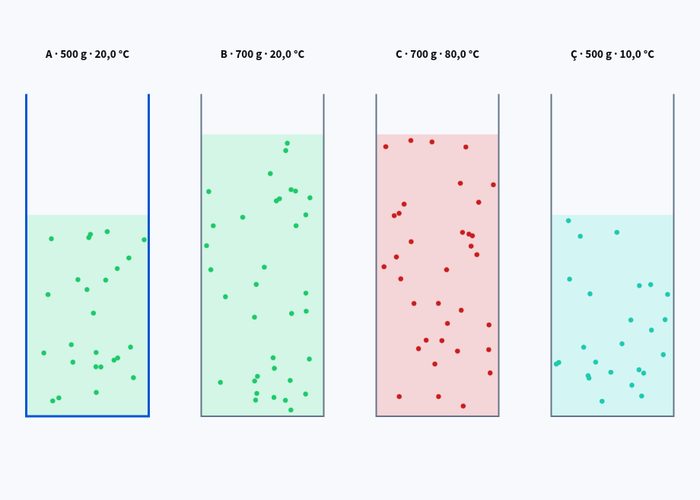
Discover the differences between these three fundamental physics concepts at the particle level with the heat, temperature, and internal energy simulation. Through this interactive activity, you can heat the containers and observe the change in particle motion, examine heat flow by bringing different containers into contact, and reinforce basic concepts.
What can you do in this simulation?
- By heating a container, you can instantly observe the change in the speed and motion of the particles.
- You can bring containers C and Ç of different temperatures and masses into contact with each other and follow the heat flow and temperature equilibrium process.
- You can explore the relationship between the average kinetic energy and the total energy of particles through the experiment.
- You can test your knowledge by solving sentence completion and true-false tests related to the concepts of heat, temperature, and internal energy.
Basic concepts and formulas
Temperature is an indicator of the average kinetic energy of the particles in a system (E_k = 3/2 k_B T). Internal energy is the sum of the kinetic and potential energies possessed by all particles in the system. Heat, on the other hand, is the energy transferred from one system to another due to a temperature difference and is expressed by the formula Q = m·c·ΔT. Heat flow always occurs from the substance with the higher temperature to the one with the lower temperature and continues until the temperatures are equalized.
How to use?
- Open the experiment screen and examine the initial state of the particles in the containers.
- Use the heating option to observe the change in the container's temperature and particle movements.
- Bring containers C and Ç into contact with each other to watch the direction of heat flow and the equalization of temperatures.
- Test your predictions about heat, temperature, and internal energy by answering the activity questions.
Frequently asked questions
Are temperature and heat the same thing?
No, temperature is a measure of the average kinetic energy of substances and is measured with a thermometer. Heat, on the other hand, is a type of energy transferred between two bodies and cannot be measured directly, it is calculated.
What does internal energy include?
Internal energy is the sum of the translational, rotational, and vibrational kinetic energies of all atoms and molecules in a system, plus their intermolecular potential energies. It varies depending on mass and temperature.
In which direction does heat flow?
Heat is always transferred from a substance with a higher temperature to a substance with a lower temperature. Heat exchange stops when the temperatures of the two substances equalize.
 Interactive experiment