Wall laboratory: heat conduction rate via material, surface area, thickness, and temperature difference; insulation design with styrofoam
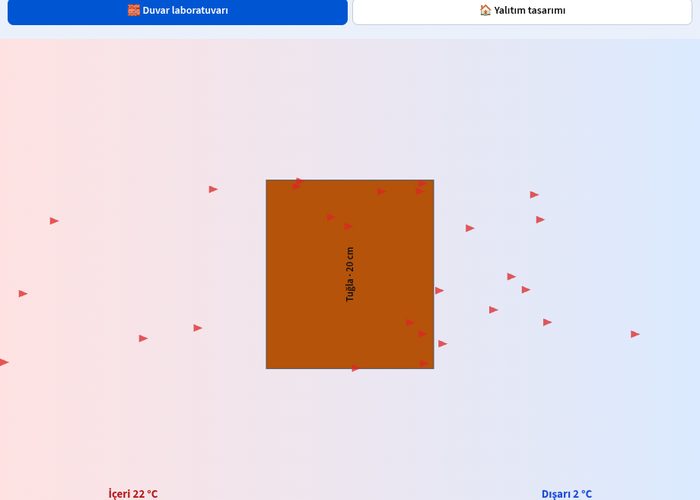
Explore interactively how material type, wall thickness, surface area, and temperature difference affect heat transfer with the heat conduction rate and insulation simulation. Through this experiment, you will see the factors that reduce energy loss in buildings and reinforce the principles of thermal insulation. You will learn the importance of the thermal conductivity coefficient by experimenting with different materials such as pure aluminum, steel, brick, wood, and glass wool.
What can you do in this simulation?
- You can observe the rate of heat conduction by selecting different wall materials (pure aluminum, steel, brick, wood, glass wool).
- You can examine the effect of dimensions on heat loss by changing the thickness and surface area settings on the brick wall.
- You can test the role of the temperature difference between the indoor and outdoor environment by changing the outdoor temperature values.
- You can try to reduce heat loss by designing insulation with insulating materials such as styrofoam.
- You can test your knowledge and perform error analysis by answering the questions guided by the mentor.
Basic concepts and formulas
The rate of heat conduction shows how fast materials transfer heat. According to Fourier's law of heat conduction, the rate of heat conduction is calculated with the formula Q/t = k·A·(T1 - T2) / d. Here, Q/t represents the rate of heat conduction, k the thermal conductivity coefficient, A the surface area, T1 - T2 the temperature difference, and d the wall thickness. The goal in insulation is to decrease the k coefficient and area, and to increase the thickness.
How to use?
- Go to the experiment panel, read the guide, and examine the given tasks.
- Observe the change in the rate of heat conduction by selecting different wall materials from the material list.
- Check your predictions by changing thickness, surface area, and outside temperature parameters.
- Apply appropriate materials to reduce heat loss to the target value in the insulation design task.
Frequently asked questions
Where are materials with a high thermal conductivity used?
Materials with a high thermal conductivity are preferred in radiators and kitchen utensils that require rapid heat transfer.
Why are insulation materials used in buildings?
For thermal insulation, materials with a low thermal conductivity, such as glass wool or styrofoam, are chosen to prevent heat loss in winter and heat gain in summer.
How does the temperature difference affect the rate of heat conduction?
As the temperature difference between the indoor and outdoor environments increases, the rate of heat conduction through the wall also increases in direct proportion.
 Interactive experiment