Trigonometric equations: find solutions to sin x = k and cos x = k equations in the interval [0, 2π) at the intersections of a horizontal line and the graph, and on the unit circle; calculate moments at the desired height in the Ferris wheel problem
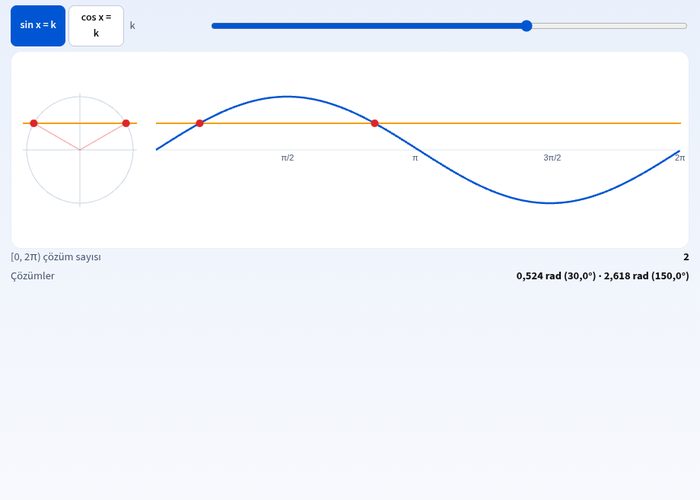
Interact with the equation problems simulation using trigonometric functions to discover solutions to sin x = k and cos x = k equations in the interval [0, 2π). Thanks to this experiment, you will easily learn intersections on the unit circle, graph changes, and height calculations required in ferris wheel problems.
What can you do in this simulation?
You can test correct answers and see your success score on the first try.
You can follow the steps accompanied by a guide, and place cards into the correct boxes by dragging and dropping.
You can discover 3 different situations and the number of solutions in the ferris wheel model by choosing a height of 29 m.
You can save your predictions and test them with the experiment, and return to steps where you fell short or struggled.
You can completely control the simulation flow using forward and restart buttons.
Basic concepts and formulas
Trigonometric equations are solved with the help of the unit circle or graphs. The equation sin x = k typically has two distinct roots in the interval [0, 2π). If the principal angle is x₁, the second root is expressed as x₂ = π - x₁ (for sine) or x₂ = 2π - x₁ (for cosine). In real-life scenarios such as ferris wheel problems, these periodic changes are modeled with sine and cosine functions.
How to use?
Read the questions and instructions carefully through the guide panel.
Place the cards into the relevant boxes or correct columns by tapping or dragging and dropping.
Make your prediction and test your answer by pressing the "Check" button.
If necessary, repeat the steps using the "Restart" button and fully solve the model.
Frequently asked questions
How is the solution set of trigonometric equations found?
For the equations sin x = k or cos x = k given in the interval [0, 2π), the principal angle in the first quadrant is found first, and then the other root is calculated using symmetry properties.
Why are ferris wheel problems solved with trigonometry?
The height of the ferris wheel changes periodically depending on time or the angle of rotation; this situation directly matches the wave graphs of sine and cosine functions.
What does the interval [0, 2π) mean?
It represents a full turn on the unit circle where 0 is included and 2π radians (360 degrees) are excluded.
 Interactive experiment