Divisibility rules: check divisibility by 2, 3, 4, 5, 6, 8, 9, 10, and 11 using digit rules; build the number and see why the rule works; finding missing digits
Explore and reinforce the divisibility rules for 2, 3, 4, 5, 6, 8, 9, 10, and 11 interactively with the divisibility simulation. This interactive tool allows you to test the evenly divisible properties of numbers using digit rules and solve math problems faster. You can solidify the foundations of number theory with this experiment suitable for the high school mathematics curriculum.
What can you do in this simulation?
You can test the divisibility rules for 2, 3, 4, 5, 6, 8, 9, 10, and 11 step by step.
You can solve matching puzzles by dragging and dropping or tapping the cards into the appropriate boxes.
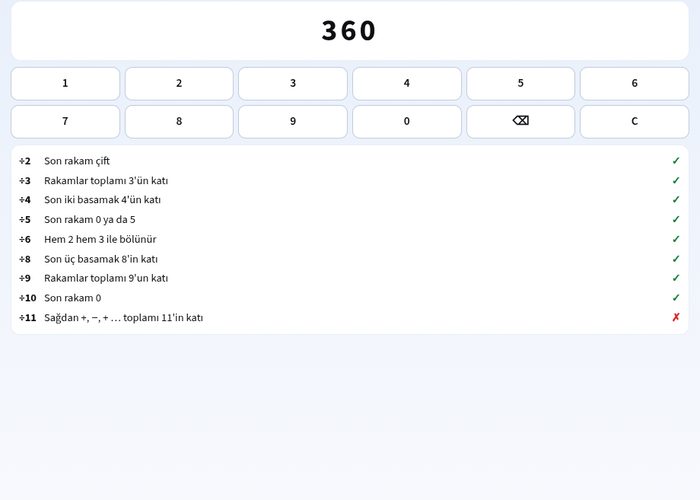
You can instantly examine which rules the generated number complies with.
You can check the correct answers guided by the tutor and make use of hints when you get stuck.
You can reset the simulation using the restart button and practice with different numbers.
Basic concepts and formulas
Divisibility rules allow us to understand whether a number can be divided by another number without a remainder (remainder 0) without performing a long division. For example, for a number to be divisible by 2, its last digit must be even (0, 2, 4, 6, 8); for it to be divisible by 3, the sum of its digits must be a multiple of 3 or 3. For divisibility by 11, the sum obtained by assigning +, -, +, - signs respectively to the digits of the number from right to left is checked to be a multiple of 11.
How to use?
Start the Divisibility Rules simulation by opening the page.
Examine the cards presented on the screen and place them in the boxes according to the rules they belong to.
Test the accuracy of your guesses by pressing the check button.
Move on to other puzzles with the next button and complete all tasks.
Frequently asked questions
How do I know if a number is divisible by 6?
For a number to be evenly divisible by 6, it must be divisible without a remainder by both 2 and 3 at the same time.
What is the divisibility rule for 4?
If the last two digits of a number are a multiple of 00 or 4, that number is evenly divisible by 4.
How is the divisibility rule for 11 applied?
The number is marked with +, -, +, - from right to left, and the sum of these digits must be a multiple of 11.
 Interactive experiment