Prime factors and divisors: factor a number into its prime factors using a factor tree; find the number of positive divisors (product of exponents + 1) and divisors from the prime factorization
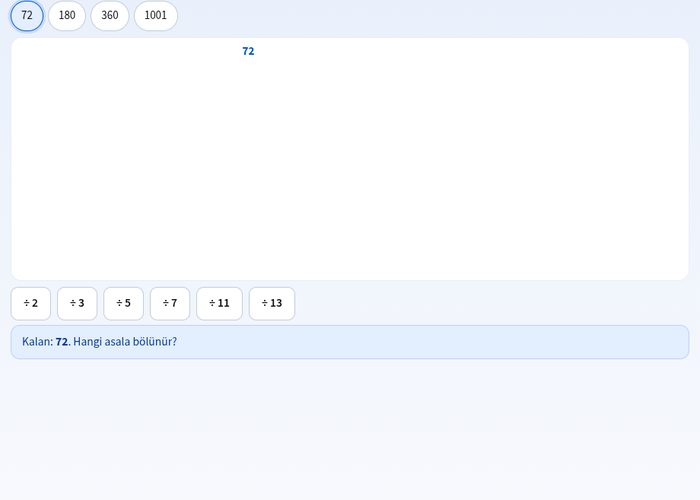
With the Prime Factors and Divisors of a Natural Number simulation, you can interactively learn how to factor numbers, find the number of positive divisors, and use the factor tree method. This educational tool is designed to help you reinforce number theory topics in math. ## What can you do in this simulation? - You can factor a number into its prime factors using a factor tree. - You can follow the steps by dividing the numbers you choose by appropriate prime numbers. - You can test what you have learned by dragging and dropping cards into the correct boxes. - You can check the correct answers with the guidance of the guide and fill in your gaps. ## Basic concepts and formulas When a natural number is written as the product of its prime factors, it takes the form A = p1^a · p2^b · p3^c. Based on this notation, the number of positive divisors is calculated with the formula NPD = (a + 1)·(b + 1)·(c + 1). ## How to use? 1. Go to the experiment panel and select your starting number. 2. Grow the factor tree using appropriate prime numbers. 3. Place all blanks and cards in the correct boxes. 4. Test your result by clicking the check answer button. ## Frequently asked questions ### What is a prime factor? A prime factor is each of the prime numbers that divides a number without a remainder. For example, the prime factors of the number 12 are 2 and 3. ### How to find the number of positive divisors? After the number is factored into its prime factors, the exponent of each prime factor is increased by 1 and these values are multiplied by each other. ### What is a factor tree used for? A factor tree allows you to visualize a number by breaking it down step by step into its smallest prime factors.
 Interactive experiment