Environmental effects of metals, alloys, and nanoparticles: simulation of bioaccumulation of heavy metals in the food chain; recycling of waste batteries and electronic waste; advantages of alloys
Explore the processes of heavy metal bioaccumulation in the food chain with the simulation of the environmental impacts of metals, alloys, and nanoparticles. In this interactive experiment, you will learn the concept of sustainability by examining the release of waste batteries, electronic waste, and industrial residues into nature.
What can you do in this simulation?
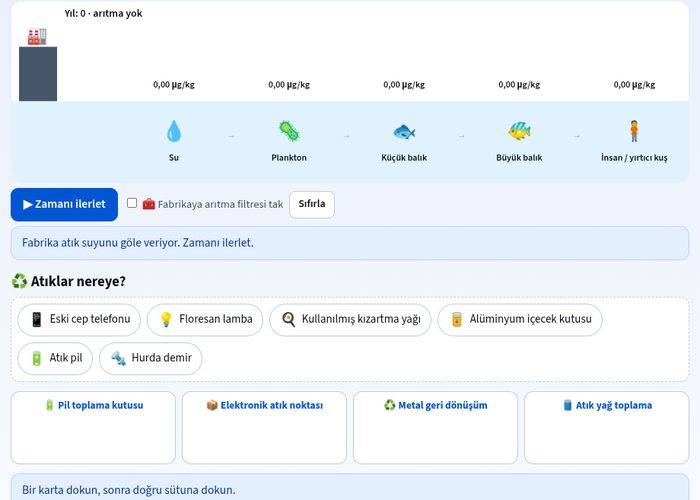
You can observe the accumulation in the food chain over time by adjusting the mercury release.
You can place wastes such as waste batteries, old cell phones, fluorescent lamps, and scrap iron into the correct categories.
You can test the impact of environmental protection measures by comparing scenarios with and without treatment.
You can reinforce why alloys are preferred (hardness, corrosion resistance, melting point) with multiple-choice questions.
You can track your score and correct your mistakes by progressing step by step with the guide.
Basic concepts and formulas
The phenomenon where chemical substances and heavy metals do not decompose in nature and increase in concentration as they move up the food chain is called bioaccumulation (biological accumulation). As elements such as mercury and lead are transferred from producers to consumers (from small fish to large predatory fish and humans), their toxic effect multiplies. Alloys, on the other hand, are obtained by melting and mixing metals to improve their properties, and sustainable recycling processes play a critical role in waste management.
How to use?
Go to the experiment panel and adjust the amount of mercury release and treatment options.
Place the wastes on the cards (waste battery, aluminum can, etc.) into the correct boxes by tapping or dragging and dropping.
Track the changes in bioaccumulation in the food chain by observing the progression of time.
Answer the questions that appear and test your predictions with simulation data.
Repeat the experiment by going back to the steps where you made mistakes or missed something.
Frequently asked questions
What is bioaccumulation?
It is the buildup of harmful chemicals and heavy metals in the bodies of living organisms over time because they cannot be excreted, increasing in concentration as one moves up the food chain.
Why are alloys preferred?
Compared to pure metals, they allow physical properties such as hardness, corrosion resistance, and durability to be improved according to engineering needs.
Why is the recycling of electronic waste important?
It is critically important to prevent heavy metals such as mercury and lead contained in them from being released into the environment, causing water and soil pollution, and to preserve natural resources.
 Interactive experiment