Metal nanoparticles: divide the cube and see how the surface-to-volume ratio increases; size–color relationship in silver (AgNP) and copper (CuNP) nanoparticle synthesis; fields of application in nanotechnology
Explore the fundamentals of nanotechnology, the change in the surface-area-to-volume ratio through the cube subdivision method, and the size-color relationship in the synthesis of silver and copper nanoparticles with the metal nanoparticles simulation. In this interactive experiment, you will observe how the surface area increases by subdividing the cube and learn about the sustainable applications of nanomaterials in daily life.
What can you do in this simulation?
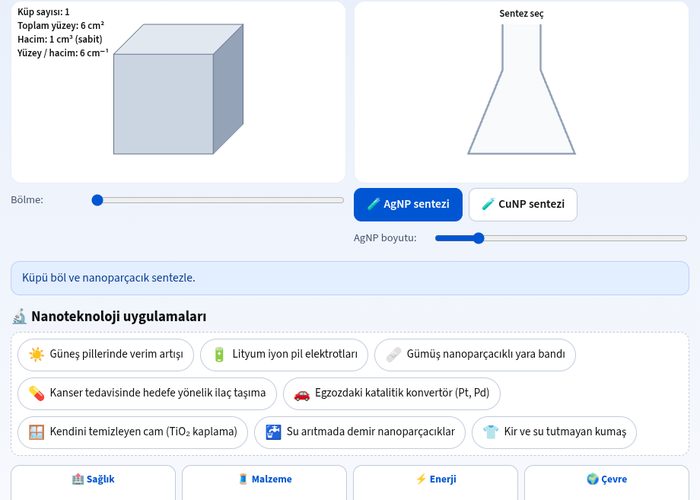
Using the cube subdivision tool, you can divide the cube into 10 parts per edge and instantly track changes in the number of cubes, total surface area, and the surface-to-volume ratio.
You can understand the relationship between size and color by examining the steps of silver and copper nanoparticle synthesis.
You can place 8 different nanotechnology applications, such as silver nanoparticle bandages, drug delivery in cancer treatment, self-cleaning glass, and solar cells, into the corresponding boxes.
By answering the questions with the guidance of the guide, you can test your predictions with the experiment and see your success score.
Basic concepts and formulas
Nanoparticles are materials with at least one dimension ranging between 1 and 100 nanometers. As the material size decreases, the surface area per unit volume (Surface-to-Volume ratio) increases exponentially. This ensures that chemical reactivity and catalytic activity are very high. As the cube edge length decreases at a constant volume (V = 1 cm³), the total surface area shows massive increases based on the formula (A = 6·a²).
How to use?
Go to the experiment panel, open the cube subdivision tool, and set the number of parts per edge.
Observe the increase in the total surface area and the surface-to-volume ratio along with the subdivision of the cube.
Follow the stages of silver and copper nanoparticle synthesis.
Drag and drop the cards to place the applications of nanotechnology into the correct categories.
Test your knowledge by answering the questions in the guide and repeat the experiment by clicking the restart button if necessary.
Frequently asked questions
Why is the surface-to-volume ratio so important?
As the size decreases, the number of atoms on the outer surface increases, which makes the material more active and allows it to interact with the environment faster.
In which areas are silver nanoparticles used?
They are widely used in silver nanoparticle bandages and medical materials, especially thanks to their antibacterial properties.
Why does the volume remain constant during cube subdivision?
In the simulation, the total initial volume is kept constant at 1 cm³, and only the material is divided into smaller cubes to examine the change in total surface area.
 Interactive experiment