Green hydrogen: produce H₂ and O₂ via water electrolysis using electricity from solar and wind power; calculate the amount and yield of hydrogen from electrical energy; compare gray, blue, and green hydrogen by production method and CO₂ emissions; fuel cell
Explore renewable energy sources, water electrolysis, and hydrogen production methods interactively with the green hydrogen energy simulation. Using solar and wind energy, you can observe the production of hydrogen (H₂) and oxygen (O₂) through water electrolysis, and calculate the amount of hydrogen and efficiency from electrical energy. Learn the chemistry of a fossil-fuel-free future by reinforcing the theme of sustainability.
What can you do in this simulation?
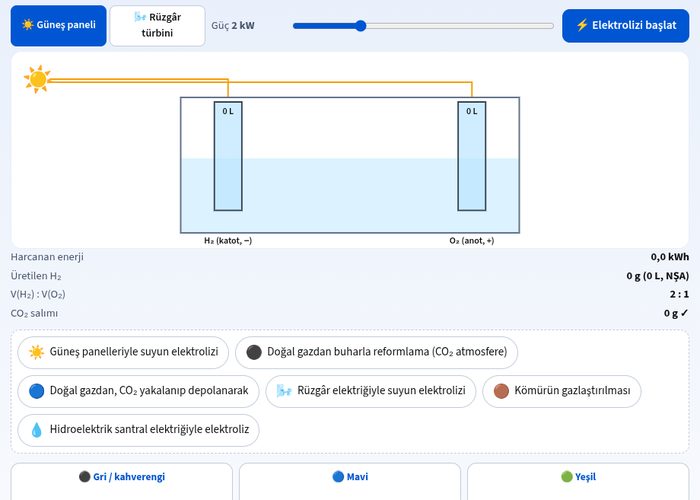
You can decompose water by starting its electrolysis using solar panels and wind electricity.
You can track the amounts of H₂ and O₂ produced, as well as the changes at the cathode and anode poles.
You can compare gray, blue, and green hydrogen production methods according to their CO₂ emissions and sources.
You can classify the colors of hydrogen and their production processes by placing the cards into the appropriate boxes.
You can test your theoretical knowledge with practice by answering the questions with the help of the guide.
Basic concepts and formulas
Green hydrogen is produced by the electrolysis of water using electricity obtained from renewable energy sources. Water molecules decompose into hydrogen and oxygen with the help of an electric current:
2H₂O + Electrical Energy → 2H₂ + O₂
Carbon emissions are zero in this process. Gray hydrogen is produced through the reformation of natural gas (with CO₂ emissions), while blue hydrogen is produced from natural gas using a method where carbon is captured and stored.
How to use?
Go to the experiment panel and read the guide's instructions.
Run the electrolysis with solar or wind energy and observe the decomposition of water.
Drag and drop the cards related to hydrogen colors and production methods into the correct boxes.
Complete the calculations and questions to check your results.
Repeat the experiment starting from the beginning to review missing steps.
Frequently asked questions
What is green hydrogen?
Green hydrogen is a clean energy carrier produced by the electrolysis of water using electricity obtained entirely from renewable energy sources such as solar and wind, with no carbon emissions.
Which gases are released during the electrolysis process?
As a result of the electrolysis of water, hydrogen (H₂) gas is released at the cathode (-), and oxygen (O₂) gas is released at the anode (+) pole.
What is the difference between gray and green hydrogen?
Gray hydrogen is produced from natural gas via steam methane reforming, releasing CO₂ into the atmosphere, whereas green hydrogen is produced using renewable electricity and has zero carbon emissions.
 Interactive experiment