Atmospheric reactions and global issues: pH of rainwater with SO₂ and NOₓ emissions (acid rain), effect of CFCs on the ozone layer, greenhouse gases; reactions and solutions
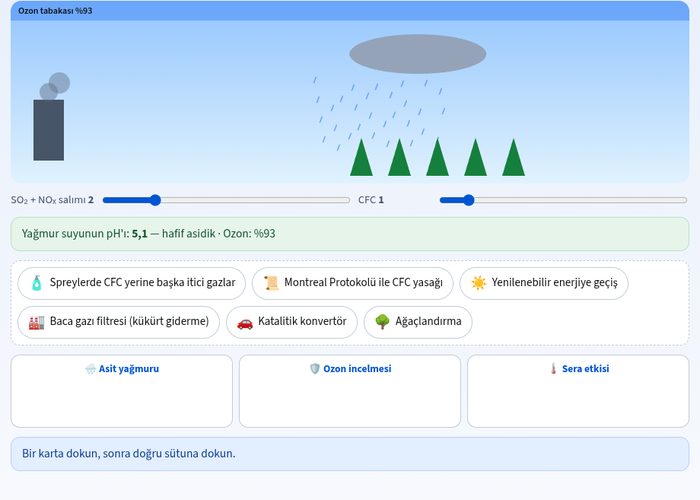
Interactively explore the effect of SO₂ and NOₓ emissions on acid rain, the damage caused by CFCs to the ozone layer, and the role of greenhouse gases with the reactions in the atmosphere and global issues simulation. Through this experiment, you can learn chemistry-based environmental problems and solutions through interactive scenarios. While reinforcing the theme of sustainability, you will have the opportunity to directly observe critical processes such as ozone layer depletion and flue gas filtration.
What can you do in this simulation?
You can examine the pH change of rainwater by altering the emission amount of SO₂ and NOₓ.
You can observe the negative impacts of acid rain on forests and lakes.
You can track the change in ozone percentage and the increase in UV rays by adjusting CFC emissions.
You can place 6 key solutions such as flue gas filters, the transition to renewable energy, and the Montreal Protocol into the correct spots.
You can test your predictions with the experiment by answering questions accompanied by the guide and receive instant feedback.
Basic concepts and formulas
Sulfur dioxide (SO₂) gas in the atmosphere reacts with water to form sulfurous acid (H₂SO₃) and over time converts to sulfuric acid (H₂SO₄), lowering the pH value of rainwater. Similarly, nitrogen oxides (NOₓ) lead to acid rain by forming nitric acid (HNO₃). CFC components break down in the stratosphere under the influence of UV rays, converting ozone (O₃) molecules into oxygen and causing the ozone layer to thin. The fundamental pH relationship for acid rain is explained by the formula pH = -log[H⁺].
How to use?
Open the experiment panel and read the information provided about atmospheric reactions and global issues.
Observe the pH and ozone percentage changes in the system by changing emission rates and gas levels.
Examine the cards and place them into the correct boxes or columns by tapping or dragging and dropping.
Test your answer by pressing the Check button and review the steps where you made mistakes.
Successfully complete the experiment by matching the solutions and taking steps like the Montreal Protocol and renewable energy.
Frequently asked questions
How does acid rain affect the pH value of water?
SO₂ and NOₓ gases react with water vapor in clouds to form acids, dropping the pH of normally slightly acidic rainwater to dangerous levels.
Why do CFC gases damage the ozone layer?
Chlorofluorocarbons dissociate into chlorine radicals in the stratosphere under the influence of ultraviolet rays, and these radicals break down ozone molecules, leading to the depletion of the ozone layer.
Why is the Montreal Protocol important?
The Montreal Protocol is one of the most successful environmental agreements solved through global cooperation by banning the production of chemicals like CFCs that harm the ozone layer.
 Interactive experiment