Sustainable development: choose saving habits at home and calculate your annual water, electricity, and carbon savings; throw waste into the correct recycling bin and see the resource and energy gain of recycling
Discover the environmental impact of daily habits and learn how to save energy with the sustainable development simulation. In this interactive experiment, you can observe how your ecological footprint shrinks as you choose steps that save water, electricity, and carbon. You can also practice waste management and resource conservation by placing different wastes into the correct recycling bins. Explore the positive results of eco-friendly choices on our planet right away.
What can you do in this simulation?
You can select saving habits that can be applied at home (LED bulb, short shower, turning off the tap, etc.).
You can calculate the annual amount of water, electricity, and carbon saved.
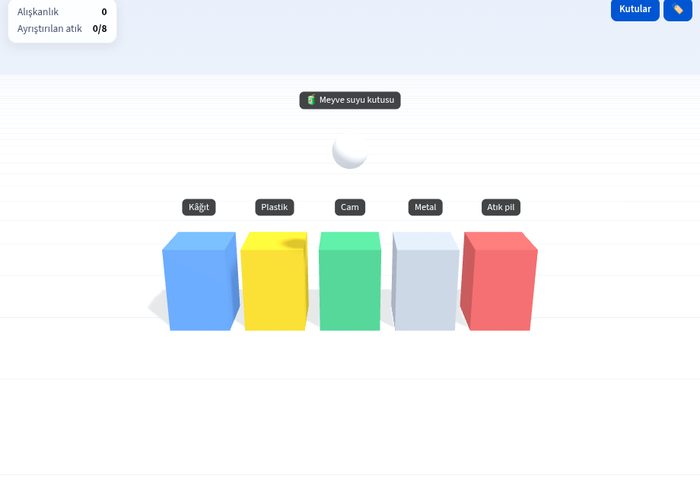
You can sort different wastes such as juice boxes, glass bottles, newspapers, plastic bottles, and batteries into the correct recycling bins.
You can test your sustainable living awareness by answering questions guided by the mentor.
You can retry different scenarios by using the restart button.
Basic concepts and formulas
Sustainable development is the process of meeting today's needs without compromising the needs of future generations. Energy efficiency and recycling play critical roles in this process. The amount of energy consumed and waste produced can be expressed with the following general relationship: Ecological Impact = Consumption Amount x Unit Waste Factor. Thanks to recycling, raw material consumption decreases and the amount of greenhouse gases released into nature drops.
How to use?
Determine the appropriate options from the saving habits screen to see the change in the ecological footprint.
Tap the waste card given in the waste sorting step.
Complete the matching by selecting the correct recycling bin to which the waste belongs.
Earn the recycling expert badge by placing all wastes into the correct bins.
Frequently asked questions
Why is sustainable development important?
Sustainable development is essential to prevent the depletion of natural resources, save energy, and leave a livable environment.
Does recycling provide energy savings?
Yes, recycling wastes consumes much less energy compared to producing from raw materials and conserves resources.
What is an ecological footprint?
It is a measure of the resource consumption and waste load created by human activities in nature, compared to the planet's regenerative capacity.
 Interactive experiment