Levers: set up three types of levers by changing the positions of the fulcrum, load, and effort; adjust the effort arm and load arm, verify the equilibrium condition of Effort × Effort Arm = Load × Load Arm on a 3D seesaw, and classify everyday tools
With the levers simulation, you can discover three different lever types by changing the position of the fulcrum, load, and force, and experience the relationship between the effort arm and the load arm. Thanks to this interactive experiment, you will grasp the working principles of simple machines and easily learn which lever class everyday tools belong to.
What can you do in this simulation?
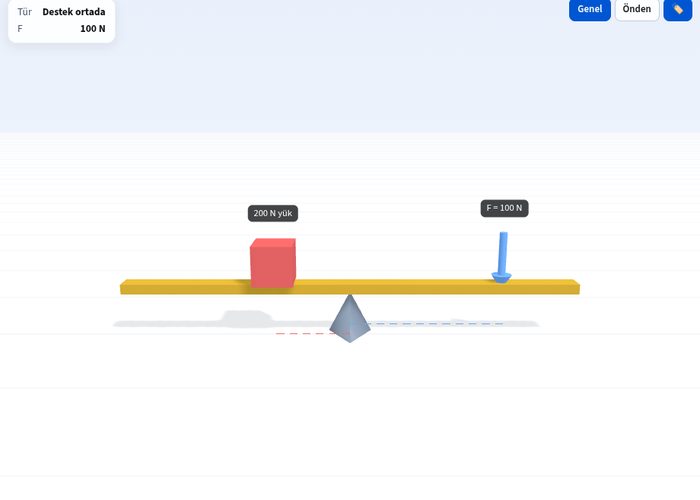
You can build three different types of levers by changing the positions of the fulcrum, load, and effort.
You can observe equilibrium by adjusting the lengths of the effort arm and load arm.
3You can test the condition for equilibrium on a seesaw model.
You can match everyday tools such as a wheelbarrow, tweezers, bottle opener, and shovel with the correct lever types.
Basic concepts and formulas
Levers are rigid bars that can rotate around a fulcrum and are used to gain mechanical advantage or change the direction of motion. The equilibrium condition is expressed by the formula F · effort_arm = L · load_arm. Depending on whether the fulcrum, load, or effort is in the middle, levers are divided into three classes.
How to use?
Go to the experiment panel to select and examine different types of levers.
Adjust the arms by changing the positions of the fulcrum, effort, and load.
Check the equilibrium condition on the seesaw and record your predictions.
Solve the classification questions by dragging everyday tools into the appropriate boxes.
Frequently asked questions
How many types of levers are there?
Levers are divided into three main groups: fulcrum in the middle, load in the middle, and force in the middle.
How is mechanical advantage calculated?
Mechanical advantage is found by the ratio of the effort arm to the load arm; the longer the effort arm, the easier the work becomes.
What are some examples of levers in daily life?
Scissors, seesaws, and pliers have the fulcrum in the middle; wheelbarrows and bottle openers have the load in the middle; tweezers and tongs are levers with the force in the middle.
 Interactive experiment