Acids and bases: drip red cabbage juice and litmus paper onto household substances, determine their pH based on color, and place them on the pH scale; neutralize acid with base drop by drop; watch acid rain corrode marble
Discover the chemical properties of substances you encounter in daily life with the Acids and Bases simulation. In this interactive experiment, by testing substances such as lemon juice, vinegar, soapy water, and bleach, you will learn their places on the pH scale and observe neutralization reactions and the effects of acid rains.
What can you do in this simulation?
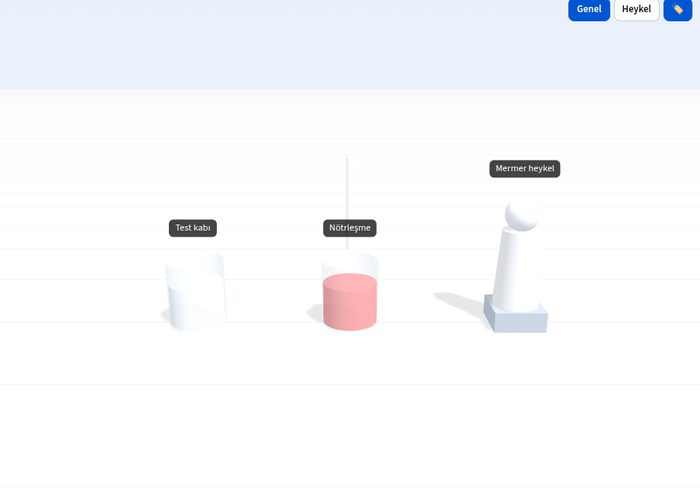
You can examine substances such as lemon juice, vinegar, carbonated drink, pure water, soapy water, carbonated water, bleach, and drain opener in the test container.
You can see the color changes of the solutions and find their pH degrees by using red cabbage juice or litmus paper.
You can correctly fill out the pH scale with the data you obtained.
You can experience the neutralization event by combining acids and bases drop by drop.
You can run and watch the corrosive effect of acid rain on the marble statue.
Basic concepts and formulas
Acids are substances that give hydrogen ions (H+) to their aqueous solutions, have a pH value of less than 7, and generally have a sour taste. Bases, on the other hand, are substances that give hydroxide ions (OH-), have a pH value ranging between 7 and 14, and give a slippery feel to the touch. The pH scale has a scale between 0 and 14; the pH = 7 point indicates the neutral state for pure water. With the coming together of acids and bases, a neutralization reaction takes place and salt and water are formed.
How to use?
Open the test container screen and select one of the substances from the list, such as lemon juice, vinegar, or soapy water.
Observe the color change by dropping indicator onto the substance and determine the pH value.
Complete the scale by placing the substance in the appropriate position on the pH scale.
Switch to the neutralization mode and perform the experiment with acid and base drops.
Observe the corrosion on the marble by running the acid rain simulation.
Frequently asked questions
What is the pH range of acids?
The pH value of acids is between 0 and 7. As it approaches 0, the acidity strength increases.
What is formed in a neutralization reaction?
As a result of the reaction between an acid and a base, salt and water are formed, and the medium approaches neutrality.
Is bleach an acid or a base?
Bleach is a strong base and its pH value is greater than 7.
 Interactive experiment