Chemical reactions: observe the vinegar–baking soda reaction on a scale in open and closed containers to discover the conservation of mass; construct a water molecule from hydrogen and oxygen using atomic models and see that the number of atoms is conserved in the reaction
Step into the world of chemistry with the chemical reactions simulation and interactively discover how substances transform and the law of conservation of mass. This simulation allows you to observe vinegar and baking soda reactions on a balance to understand that mass is conserved, and to build water molecules from hydrogen and oxygen using atomic models. By embodying abstract concepts from science class and offering the opportunity to conduct experiments, this tool will provide you with a lasting learning experience.
What can you do in this simulation?
You can observe the reaction between vinegar and baking soda in closed and open containers on a balance.
You can discover the secret of the conservation of mass using experimental data.
You can build water molecules from hydrogen and oxygen using atomic models.
You can examine reaction types such as synthesis, analysis, and the combustion of natural gas.
You can observe the decomposition of water into hydrogen and oxygen via electrolysis.
Basic concepts and formulas
In chemical reactions, the sum of the masses of the reactants is equal to the sum of the masses of the products. This phenomenon is called the law of conservation of mass. For example, the water formation reaction is expressed as 2 H₂ + O₂ -> 2 H₂O; here, the number and type of atoms remain constant throughout the reaction.
How to use?
Open the experiment panel and select the container type for the vinegar and baking soda reaction.
Observe the mass changes on the balance and record your prediction.
Switch to the atomic models tab, follow the instructions, and create 2 H₂O.
Reinforce your knowledge by answering questions on synthesis and analysis types.
Frequently asked questions
Is mass always conserved in chemical reactions?
Yes, in all chemical reactions taking place in closed systems, the total mass is strictly conserved; the types and numbers of atoms do not change.
Why are atom numbers important when forming a water molecule?
The number of atoms in the reactants must equal the number of atoms in the products, because atoms cannot be created or destroyed.
What is the difference between reactions in an open container and those in a closed container?
In open containers, if gas escapes, the mass may appear to decrease, but in a closed container, since all gases are weighed, it is clearly seen that mass is conserved.
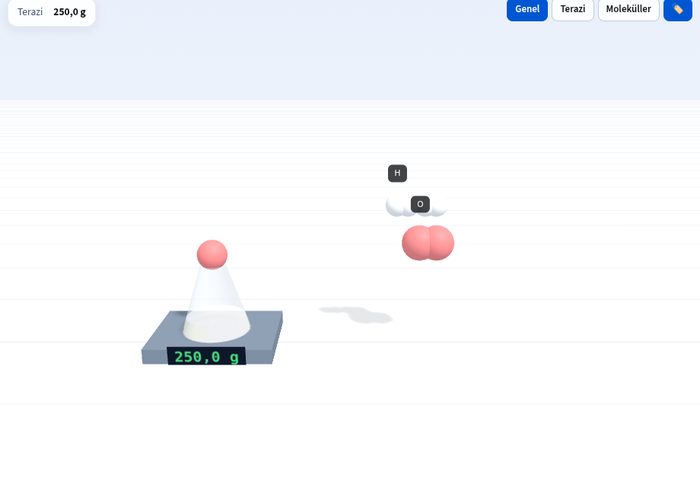 Interactive experiment