Gas pressure and pressure technologies: evacuate the air in the bell jar with a vacuum, watch the balloon inflate; measure with a barometer that atmospheric pressure decreases as altitude increases; discover that the force you apply to the small piston in a hydraulic lift raises the car on the large piston
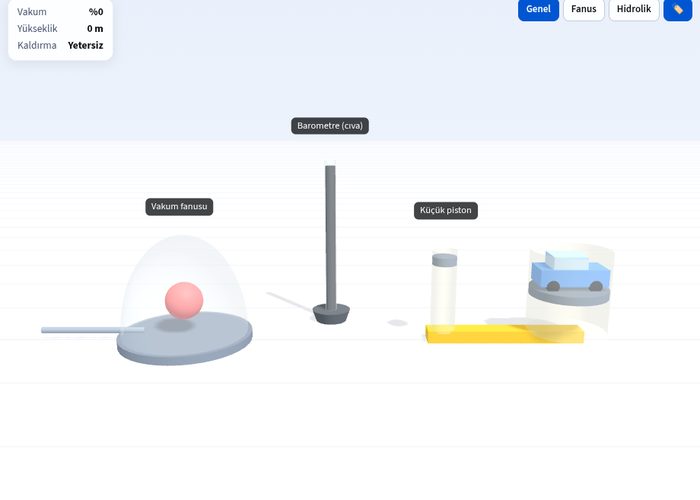
Interact with fluid pressure, atmospheric pressure, and Pascal's principle through the gas pressure and pressure technologies simulation. In this experiment, you can observe how a balloon inflates by evacuating the air in the bell jar, measure the effect of altitude change on atmospheric pressure with a barometer, and examine how a small force lifts a large car with the help of a hydraulic lever.
What can you do in this simulation?
You can extract the air inside using the vacuum bell jar and see the change in the volume of the balloon.
You can measure that atmospheric pressure decreases at different altitudes with the help of a barometer.
You can experience lifting a car on the large piston by applying force to the small piston in a hydraulic lever.
You can solve matching questions that reinforce concepts related to solid, liquid, and gas pressure.
Basic concepts and formulas
Gases exert pressure in all directions on the container they are in due to the motion of the molecules they contain. Atmospheric pressure (P0) drops as you go higher from sea level due to the decrease in gas density in the atmosphere. Liquids in closed containers transmit pressure equally in all directions; this is called Pascal's principle and is expressed by the relation F1 / S1 = F2 / S2.
How to use?
Select one of the bell jar, barometer, or hydraulic lever modes on the experiment screen.
Observe the changes in gas pressure by modifying the vacuum or altitude settings.
Examine the movement of the car by applying force to the small piston in the hydraulic system.
Test your knowledge by answering the questions in the guide panel and check your results.
Frequently asked questions
Why does the balloon in the vacuum bell jar inflate?
When the air in the bell jar is evacuated, the external pressure decreases. Since the gas pressure acting on the balloon from the inside becomes greater than the external pressure, the balloon expands.
Why does atmospheric pressure decrease as altitude increases?
The atmospheric layer surrounding the Earth is more densely gathered at the bottom due to the effect of gravity. As you go higher, the weight and density of the air column above us decrease, so the pressure also drops.
By which principle do hydraulic levers work?
Based on the principle that liquids are incompressible and transmit the pressure applied to them equally in all directions (Pascal's Principle), large loads can be lifted with small forces.
 Interactive experiment