Solid pressure: place a brick on different surfaces in a sandpit, add bricks on top; discover from the sinking depth that pressure is directly proportional to weight and inversely proportional to surface area; reinforce with snowshoe and knife examples
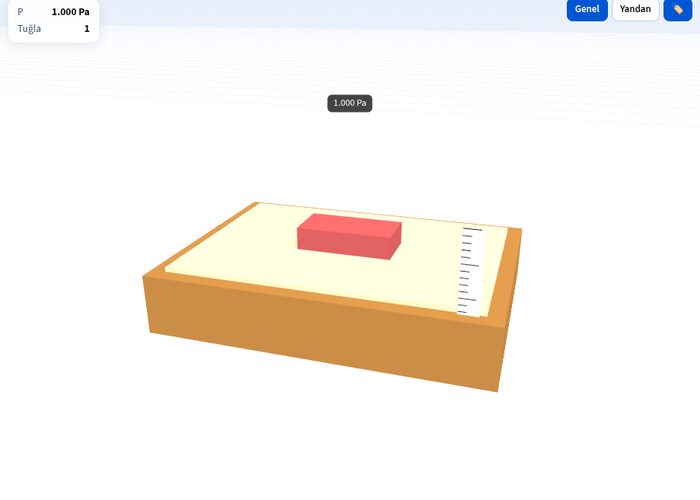
You can easily learn the effect of weight and pressure on surface area by observing the sinking depth of a brick in a sandbox with the solid pressure simulation. Thanks to this interactive experiment, you can reinforce the relationship between solids and pressure with examples from daily life while also preparing for science exams.
What can you do in this simulation?
You can place the brick into the sandbox on different surfaces: the wide face (20x10 cm), the side face (20x5 cm), and the narrow face (10x5 cm).
You can discover that surface area is inversely proportional to pressure by examining the sinking depth in the sandbox.
You can see that pressure is directly proportional to weight by adding bricks on top to increase the weight.
You can practice by placing everyday examples, such as making a knife sharp, using snowshoes, or the tip of a drawing pin, into their respective categories.
Basic concepts and formulas
The pressure exerted by solids on a surface is calculated by dividing the weight of the object by the surface area it contacts. Its formula is P = F / A; where P represents pressure (in Pascals or N/cm²), F represents the normal force applied to the ground (weight), and A represents the contact surface area. Pressure increases as the surface area decreases or as the weight increases.
How to use?
Select the brick from the experiment panel and place it in the sandpit.
Select different surface areas (wide, side, narrow face) and compare their sinking depths.
Observe the effect of the total weight on sinking by adding new bricks on top.
Test your knowledge by completing the questions in the guide and the card-matching activities.
Frequently asked questions
How does solid pressure depend on surface area?
Solid pressure is inversely proportional to surface area. As the surface area decreases, the pressure exerted by the same weight increases, which is why sharp points sink deeper.
How does pressure change if weight increases?
When the weight of an object increases, the perpendicular force applied to the surface also increases. Provided that the surface area remains constant, an increase in weight directly increases the pressure.
What are some examples of solid pressure in daily life?
The sharpness of a knife blade increases pressure to make cutting easier. The wide base of snowshoes reduces pressure to prevent sinking into the snow.
 Interactive experiment