Climate and weather patterns: heat land and sea under the Sun; see that heated air rises and creates low pressure, and wind blows from high pressure to low pressure; discover night-day breezes and the difference between weather events and climate
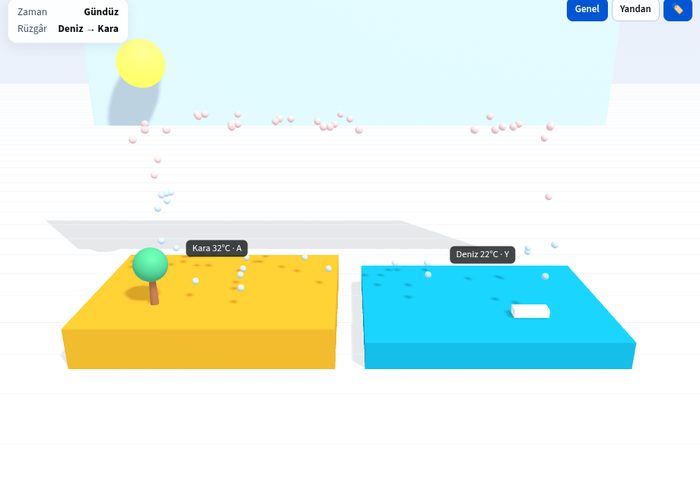
Explore the heating differences of lands and seas under the Sun, the formation of low and high pressure areas, and the direction of the wind with the climate and weather patterns simulation. In this interactive experiment, you will examine daytime and nighttime breezes and learn the fundamental differences between weather events and climate.
What can you do in this simulation?
You can observe the heating status of land and sea by changing day and night modes.
You can examine the low-pressure areas formed by heated air expanding and rising.
You can notice the high-pressure areas formed by cold air condensing and sinking.
You can see the wind blowing from high pressure to low pressure (from sea to land or from land to sea).
You can test weather event and climate concepts with matching cards.
Basic concepts and formulas
Pressure differences in the atmosphere are caused by temperature changes. As the air over the land, which is heated rapidly by the Sun, rises to form a low-pressure (L) area, the air over the sea, which heats up more slowly, remains cold to form a high-pressure (H) area. Wind is horizontal air movement and always blows from a high-pressure area to a low-pressure area.
How to use?
Open the experiment panel and select either day or night options.
Observe the temperature and pressure changes over land and sea.
Track the direction of the wind (from sea to land or land to sea).
Drag and drop the cards to place weather event and climate examples into the correct boxes.
Answer the questions and check the correct answers.
Frequently asked questions
Why does wind blow from high pressure to low pressure?
Pressure difference alters the molecular density of the air. The compressed air in the high-pressure area tries to achieve equilibrium by moving towards the less dense low-pressure area.
In which direction does the daytime breeze blow?
During the day, land heats up faster than seas. Due to the low pressure formed on land and the high pressure over the sea, the wind blows from the sea towards the land.
What is the difference between a weather event and climate?
While weather events refer to instantaneous conditions that change in a short time over a narrow area (e.g., fog, rain), climate is the average of weather conditions observed over a broad region for many years.
 Interactive experiment