Seasons: Revolve Earth around the Sun; compare the angle of incidence of rays, shadow length, and day length on June 21, September 23, December 21, and March 21 thanks to the axial tilt; zero out the tilt and see the disappearance of seasons
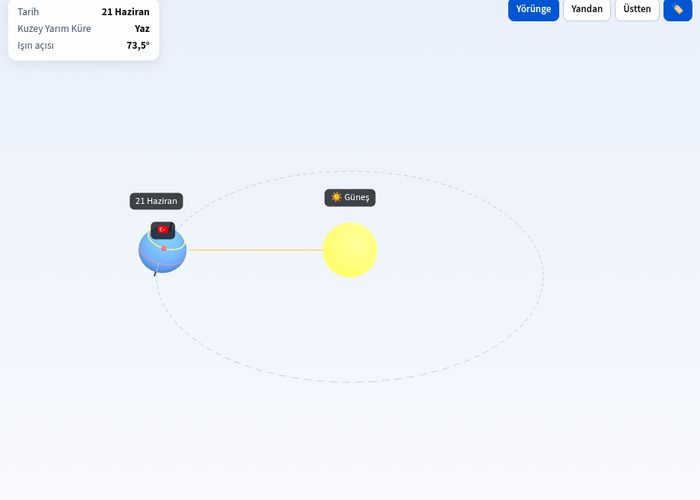
With the seasons formation simulation, you can interactively examine Earth's revolution around the Sun and the effect of axial tilt on the seasons. By selecting 21 June, 23 September, 21 December, and 21 March, you can compare the angle of incidence of sunlight, shadow length, and day length across different seasons. You can discover for yourself how seasons disappear by setting the axial tilt to 0°.
What can you do in this simulation?
You can change Earth's position in its orbit by using the date buttons for 21 June, 23 September, 21 December, and 21 March.
You can examine the angle of incidence of sunlight, shadow length, and day length for different dates.
By setting the axial tilt to 0°, you can observe how seasons and ray angles change when there is no tilt.
You can analyze the opposite seasons in the Northern and Southern Hemispheres and the amount of energy falling per unit area.
You can reinforce what you have learned by solving the interactive questions and card matching steps in the experiment and guide panel.
Basic concepts and formulas
There are two main reasons for the formation of seasons: Earth's revolution around the Sun and an axial tilt of 23,5°. In the hemisphere where the sun rays strike at a right angle or close to a right angle (close to 90°), the amount of energy per unit area increases and summer is experienced. Rays coming at an oblique angle, on the other hand, spread over a wider area and generate less thermal energy per unit area, causing winter.
The amount of energy transferred per unit area depends on the ray angle: Energy per Unit Area ∝ sin(Ray Angle)
As the angle of incidence increases, the noon shadow length shortens and the daytime duration lengthens. On 21 March and 23 September (equinox), sunlight strikes the Equator at a right angle, and night and day lengths become equal all over the world.
How to use?
Position Earth on its orbit by pressing the 21 June, 23 September, 21 December, or 21 March buttons.
Follow how the ray angle, shadow length, and day length values change on the panel for your selected date.
Observe how ray angles remain constant throughout the year when axial tilt is eliminated by using the set tilt to 0° option.
Test your predictions by completing the questions and card placement steps in the guide and experiment panel.
Frequently asked questions
Is Earth's distance from the Sun effective in the formation of seasons?
No, the primary factors in the formation of seasons are Earth's axial tilt and its revolution around the Sun. The clearest proof of this is that winter is experienced in the Northern Hemisphere while Earth is at its closest position to the Sun.
What would happen if the axial tilt were 0°?
If there were no axial tilt, the angle of incoming sunrays would not change throughout the year, seasons would not form, and night and day lengths would remain equal at 12 hours everywhere on Earth throughout the year.
How do day length and shadow length change with the angle of incidence?
As the angle of incidence of sunlight increases (becomes steeper), the energy falling per unit area increases, daytime duration lengthens, and the noon shadow length of objects shortens.
 Interactive experiment