Triangle laboratory: drag the vertices; sum of interior angles, exterior angle theorem, larger angle opposite the longer side; test triangle inequality with three rods
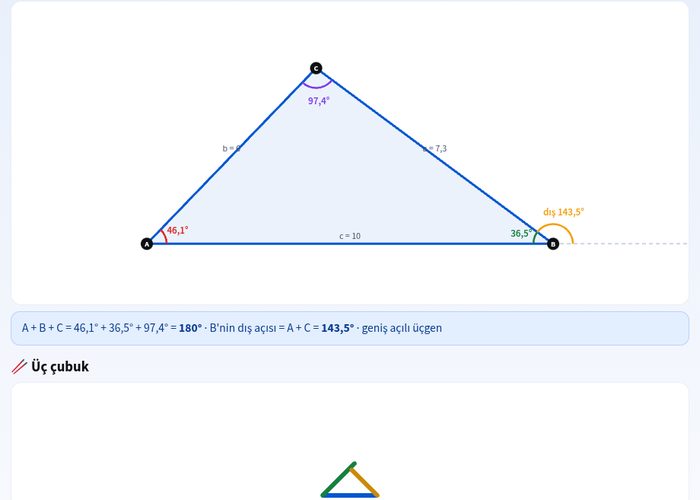
With the triangle angle and side properties simulation, you can interactively explore the interior angles, exterior angle theorem, and side-angle relationships of triangles, which are among the building blocks of geometry. Thanks to this triangle laboratory, you can drag the vertices to create acute, right, and obtuse triangles, and directly observe the relationships between angles and side lengths.\n\n## What can you do in this simulation?\n* You can test that the sum of the interior angles of a triangle is always 180 degrees by freely dragging its vertices.\n* You can individually create acute, right, and obtuse triangle types and examine the changes in the angles.\n* You can use the exterior angle theorem to see that an exterior angle is equal to the sum of its two non-adjacent interior angles.\n* You can experiment with the triangle inequality using three different sticks to discover which combinations of sticks can form a triangle.\n* You can instantly reinforce what you have learned by solving interactive questions with the help of a guide.\n\n## Basic concepts and formulas\nIn Euclidean geometry, the sum of the interior angles of any triangle is constant, and this rule is expressed as m(A) + m(B) + m(C) = 180°. In addition, the measure of any exterior angle in a triangle is equal to the sum of the measures of its two non-adjacent interior angles. Regarding side and angle relationships, the longer side is always opposite the larger angle. According to the triangle inequality, the length of any side of a triangle is less than the sum of the lengths of the other two sides and greater than the absolute value of their difference: |b - c| < a < b + c.\n\n## How to use?\n1. Open the experiment screen and drag the vertex points in the triangle laboratory to different positions with the mouse.\n2. Observe the triangle types (acute, right, obtuse) by tracking the resulting interior angle values and their sums on the screen.\n3. Check which measurements form a triangle by experimenting with the stick lengths given in the triangle inequality steps.\n4. Test your predictions and review the feedback by answering the questions in the guide panel.\n5. Repeat the experiment with different triangle combinations by clicking the "Reset" button.\n\n## Frequently asked questions\n### Is the sum of the interior angles of a triangle always 180 degrees?\nYes, in plane geometry, the sum of the interior angles of a triangle is always 180 degrees. No matter how you drag the vertices, this sum does not change.\n### Why is the triangle inequality important?\nIt allows us to understand whether any three given lengths can form a triangle. For example, a triangle cannot be drawn with sticks of lengths 3, 4, and 8 cm because the sum of two sides must be greater than the third.\n### What is an obtuse triangle?\nTriangles in which the measure of one interior angle is greater than 90 degrees are called obtuse triangles. You can easily create this angle in the simulation by dragging the vertex outward.
 Interactive experiment