Conditional probability: P(A | B) = P(A ∩ B) / P(B) in a two-way table and Venn diagram; sample space narrowing when given information; independent events
Explore the relation P(A | B) = P(A ∩ B) / P(B) on two-way tables and Venn diagrams with the conditional probability simulation. Thanks to this interactive experiment, you can easily learn how the sample space narrows and how probability is affected when an event is known to have occurred. You can improve your math skills by seeing step-by-step how given additional information and constraints change probability calculations.
What can you do in this simulation?
You can fill in two-way tables and classify data by dragging and dropping cards into appropriate boxes.
You can practice by making at least 4 different conditional probability calculations.
You can observe the narrowing of the sample space by filtering different characteristics such as female, male, wearing glasses, and not wearing glasses.
You can examine the differences between independent and dependent events through calculations.
You can navigate between steps using the next and back buttons, and check your correct answers.
Basic concepts and formulas
Conditional probability is the probability of event A occurring given that event B has occurred, denoted as P(A | B). The basic formula is as follows: P(A | B) = P(A ∩ B) / P(B). Here, P(B) > 0 must hold because it is known that event B has already occurred. If A and B are two independent events, the occurrence of one does not affect the probability of the other; that is, P(A | B) = P(A).
How to use?
Go to the experiment panel, examine the cards, and follow the instructions on the screen.
Place the cards into the correct boxes and columns by tapping or dragging and dropping them.
Calculate the requested conditional probability values based on the given information and check them.
Press the Next button to move on to new questions and test different scenarios.
Read the hints from the guide section to complete the areas where you are missing.
Frequently asked questions
Why does the sample space change when calculating conditional probability?
Because in conditional probability, we are given in advance that a certain event has occurred. This information narrows the main sample space containing all possible outcomes, allowing us to focus solely on the subset satisfying that condition.
How does conditional probability change for independent events?
For independent events, whether one event occurs does not affect the probability of the other event. Therefore, the value of P(A | B) becomes directly equal to P(A).
What data is used in this simulation?
The simulation allows you to calculate conditional probability by combining categorical data such as female, male, wearing glasses, and not wearing glasses on two-way tables.
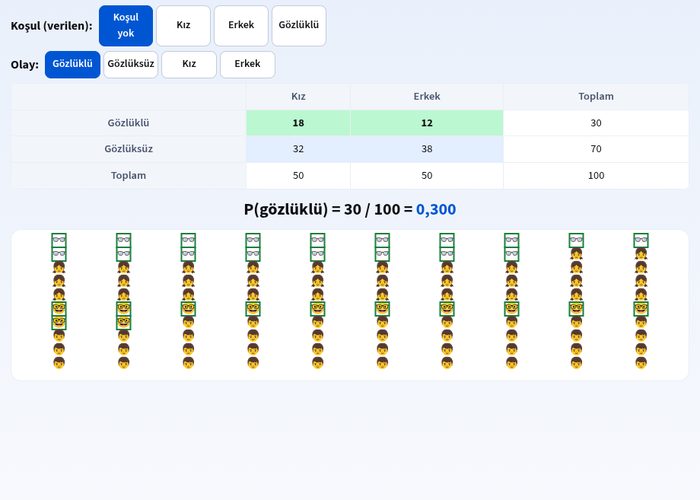 Interactive experiment