Analytical examination of a line: slope and equation of a line passing through two points; parallel and perpendicular lines (m₁ = m₂, m₁·m₂ = −1); distance from a point to a line
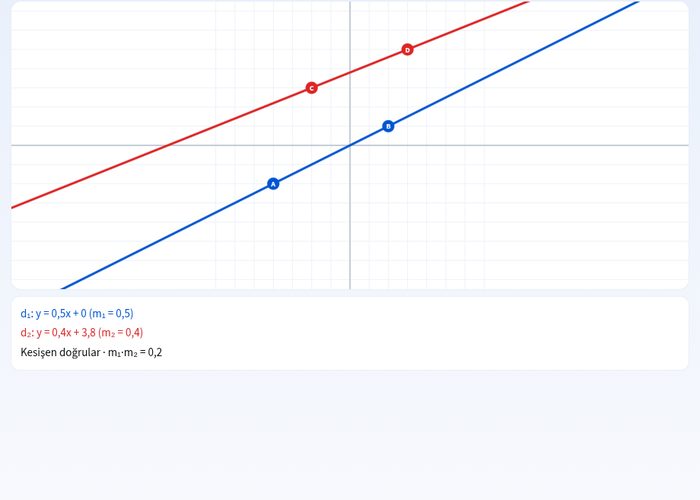
Explore the slopes of lines and their parallel and perpendicular conditions interactively in the Cartesian coordinate system with the analytical study of a line simulation. This interactive content allows you to step-by-step reinforce the relationships between two points and the rules of analytical geometry. You can easily learn geometric concepts with this tool suitable for the high school mathematics curriculum.
What can you do in this simulation?
You can calculate the slope values of the lines and observe them on the screen.
You can examine the condition where the slopes of parallel lines are equal (m1 = m2).
You can test the rule that the product of the slopes of perpendicular lines is -1 (m1 · m2 = -1).
You can test what you have learned by dragging and dropping cards into the appropriate boxes and receive instant feedback.
You can solve analytical geometry problems by progressing step by step with the guidance of the guide.
Basic concepts and formulas
The slope (m) of a line in the analytical plane is the tangent of the positive angle it makes with the x-axis. The slope of a line whose two points (x1, y1) and (x2, y2) are known is found by the formula m = (y2 - y1) / (x2 - x1). If two lines in the plane are parallel to each other, their slopes are equal (m1 = m2). If these lines are perpendicular to each other, the product of their slopes gives the value -1 (m1 · m2 = -1).
How to use?
Go to the experiment panel and read the instructions and the guide's explanations.
Observe the changes on line equations and slopes.
Test scenarios that create parallel and perpendicular conditions on the simulation.
Check your answers during the card matching and question steps.
Repeat the experiment by going back to the steps where you made mistakes or had missing answers.
Frequently asked questions
What is the relationship between the slopes of parallel lines?
Parallel lines have the same slope, meaning the relation m1 = m2 holds.
Why is the product of the slopes of perpendicular lines -1?
Due to the orthogonality condition between the direction vectors of two lines intersecting perpendicularly in the analytical plane, the product of their slopes always yields -1.
Where is the analytical study of a line used?
It is frequently used in physics motion problems, engineering designs, computer graphics, and architecture for direction and position calculations.
 Interactive experiment